I've always been a fan of quartz movements when it comes to diver's watches, or really any watch with a screw-down crown. The more the screw-down mechanism is utilized, the more likely it is to fail, and depending on the watch and precise nature of the failure, might require replacement of the entire watch case. This makes low-maintenance quartz movements the functional ideal for watches that employ screw-down crowns for their needed water resistance, as they are accurate enough to minimize the number of times you'd have to access the crown to the end of non-31-day months and the occasional, every-other-year battery change.
Actually finding a full-fledged diver's watch (meaning 300m water resistance) with a quartz movement these days, however, can be a difficult task, further compounded if you're looking for a watch that would look reasonable on a smaller (say sub-7") wrist. 42mm is the threshold for reasonableness for my 6" wrist, and sub-42mm options are very, very hard to come by.
Marathon's original TSAR (short for for "Tactical Search And Rescue"), a solid tool watch noted for its contracts for and use by government agencies, barely fit the bill at around 42mm, though its 13.5mm thickness keeps it at the very cusp of feasibility. I briefly owned one that I acquired on sale from Top Spec U.S., one of Marathon's authorized dealers, but in the end it was just a little too big and chunky for my needs.

Having once owned a Rolex Explorer I 114270 and an Omega Seamaster Pro 2253.80, I've long held 36mm as perhaps the perfect size for someone with a wrist as diminutive as mine. The Seamaster in particular was a strong contender for a lifelong diver's watch, but the demands its mechanical movement placed on its screw-down crown was simply too much for my admittedly near-OCD comfort levels. I considered its equally discontinued quartz-movement-powered doppelganger, the 2263,80, but couldn't bring myself to spend well over $1000 on a run-of-the-mill Swiss quartz.
Marathon surprised many watch commentators with the introduction of a "medium" version of its hallowed TSAR, especially in this day and age where the trend of bigger and bulkier watch sizes is showing no signs of slowing down. Their choice of a 36mm diameter seems audacious in a market where 38mm is already considered small, but not all that surprising, since the difference between 36mm and 42mm is the same 6mm that separates the TSAR (42mm) and its larger brother, the JSAR (48mm). It seems clear that Marathon intends to offer a version of its Search-and-Rescue diver's watch for consumers spanning the entire spectrum of wrist sizes.

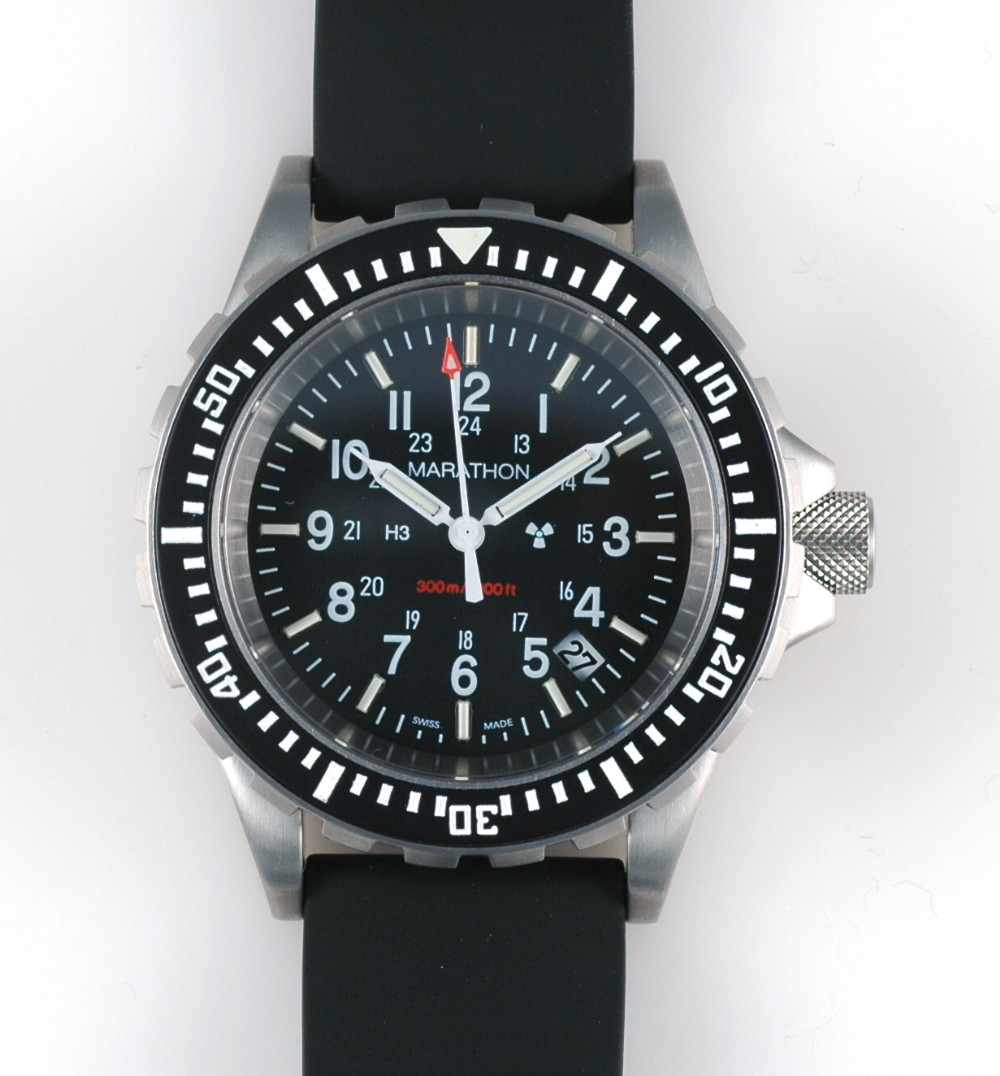
Besides being smaller and slightly less thick (12.5" versus the original 13.5"), the TSAR Medium brings the same feature set as the original: a high-torque ETA F06 Quartz with date display and end-of-life indicator (ticking at multiple-second intervals, rather than per-second), 300m water resistance, tritium tube illumination on its hour indices and hour and minute hands, and a chunky and highly visible diver's bezel with a solid ratcheting motion. It trades the original's 20mm lug width (and it's virtually endless stream of after-market compatible strap and bracelet options) for the slightly less varied but still highly versatile 18mm, which looks better proportioned to its smaller diameter.
Like all Marathon's diver's watches, the TSAR Medium comes on a rubber strap, though a redesigned one that features half-punched strap holes, allowing the user to punch through only the one they use in order to give the strap a more streamlined appearance. I'm pleased to say that, while the rubber strap on the original TSAR was too long to accommodate a 6" wrist, even at the innermost strap hole, the strap on the Medium just makes the grade at the innermost position. So 6"-wristers out there needed shell out for the matching bracelet just to find a comfortable fit.

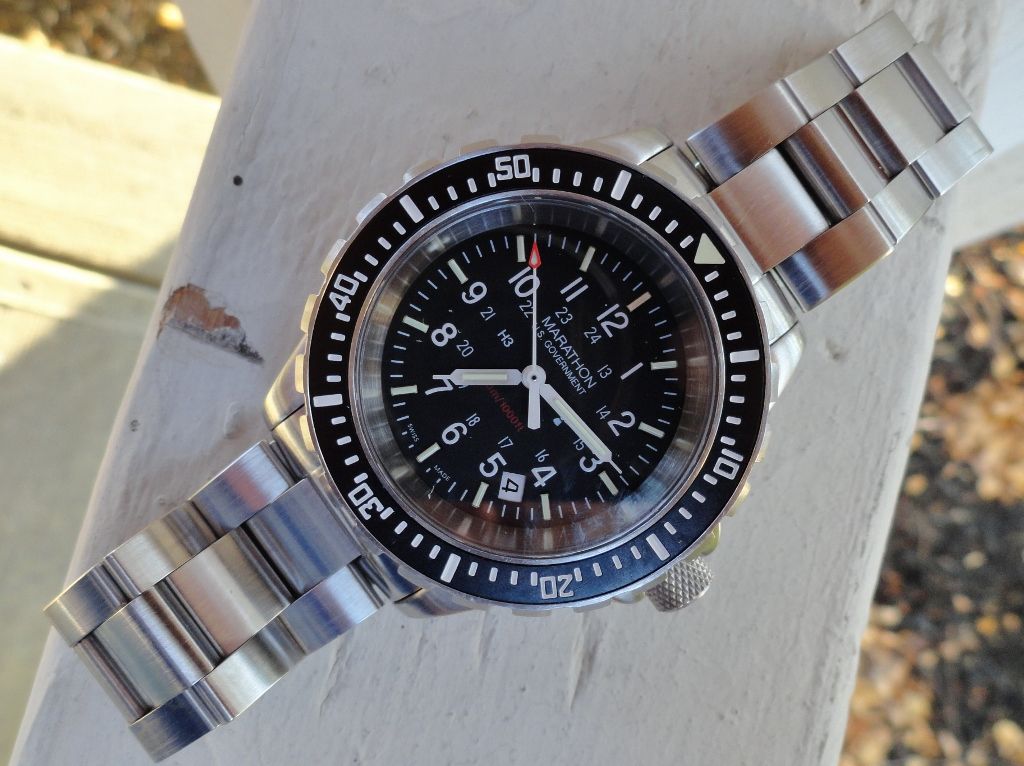
But while the bracelet is hardly necessary, it's highly recommended. It completes the TSAR look in a way that a rubber strap never could, and offers a nice nod to the TSAR's government-contracted roots with an engraved U.S. Seal on the clasp. The dual-screw system does make resizing the bracelet a bit more challenging - but not impossible - so if you're wary of damaging the bracelet in the attempt, it's probably best to seek out a qualified watch professional to do the adjustment. For those fearless enough to try it on their own, I've managed the deed with two flat-head screwdrivers of the same size, with scotch tape securing the watch to the work surface to prevent it from wriggling out of position.
At just under $500 (and just over $650 with bracelet), the TSAR Medium is admittedly pricey for a quartz watch. But if you like your watches reasonably sized and agree that the ease and accuracy of quartz is best suited to diver's watches, you'd be hard pressed to find a better in-production option than Marathon's TSAR Medium.
Case: Brushed Steel
Movement: High-Torque ETA F06 Quartz
Dial: Black
Lume: Tritium Tube
Crystal: Sapphire
Strap: Rubber (steel bracelet available)
Water Resistance: 300m
Dimensions: 36 x 43.5mm
Thickness: 12.5mm
Lug Width: 18mm
Price: $495 (+ $180 for bracelet)