Showing posts with label Watch Review. Show all posts

Tuesday, July 7, 2015

Watch Review: Rolex Oyster Perpetual 36mm 116000 Blue Arabic Dial

Several years ago, I added the first Rolex to my collection in the form of the then-newly discontinued 36mm Explorer I 114270 after what I thought was an exhaustive search of Rolex's contemporary offerings.  I'd intended the acquisition to be the sole representative of the laudable crown in my watch box, and it likely would have been, had I not been tempted to view its successor, the 39mm Explorer I 214270, at my local authorized dealer.  It wasn't that the 214270 impressed me (with its stunted hands, how could it?); it was that I laid eyes on the 116000 with its blue, Explorer-style 9-6-3 dial and updated oysterclasp bracelet, and immediately fell in love.

The result was I sold the Explorer I I'd fully intended to keep (at a slight profit, thanks to its discontinuance and having acquired it used), and bided my time and money until I could afford to purchase the 116000 new.  The time came a little sooner than I'd expected due to the introduction of the 39mm Oyster Perpetual models at Baselworld 2015 and rumored (and likely probable) discontinuance of the Arabic dial 36mm models, but I was able to negotiate enough of a deal to walk away with the Rolex I'd lusted after for nearly four years.

It had taken four years in part because I'd tried so desperately to talk myself out of the purchase.  I knew that I'd be unlikely to sell a nameless Oyster Perpetual for more than I bought it for, especially not if I bought it new, and I was loathe to sink the thousands I'd recovered and couple of hundred I'd gained from the Explorer back into another watch, much less another Rolex.  But the pull of the 116000 was so strong that I nearly purchased a gently used example from one of the preowned watch vendors at Nakano Broadway during my last trip to Japan.  In the end, it may have been for the best, as the retail experience at my local authorized dealer was top notch, and there is an ineffably exquisite quality to purchasing and subsequently wearing a watch that can claim you as its sole owner.  (Far less ineffable were the previous owner's wrist hairs that emerged from between the bracelet links of my secondhand Explorer I, when I gave it a thorough ultrasonic cleaning.)  I was afraid that, after spending over $5k on a watch - more than I've ever spent on a consumer product - I'd become bored of it in a month or two, as I have with many previous watch acquisitions (and which my long history as a watch flipper can attest to).

Going into the fourth month since picking up the 116000, I can happily report that wasn't the case.  Many WIS understand the difference between a watch that immediately speaks to you and one that does not; the latter may become an acquired favorite, after a time, but the former will always appeal to you on some primordial level, making you smile each time you glance at it, no matter how many times you already have.  Several times while wearing it, I have been times I've been tempted to winnow my five-watch rule down to an only-watch rule, with the 116000 as the sole survivor.  Only my love for the Speedy Pro - in my book the poster child for acquired favorites; it wasn't love the first time it graced my wrist (it struck me as too large, as it continues to do when paired with a bracelet), but the longer I've had it, the more and more I've grown to appreciate its immaculately designed dial, bulbous crystal, and myriad other design decisions that make it the Platonic ideal of a chronograph.  Well, that and my obsession with having a backup for nearly everything.  But if I were compelled to live an only-watch lifestyle, I have to admit that, for all of the Speedy's benefits, both technical and in heritage, I'd probably end up siding with the 116000.  It just suits me best.

Because it's not one of the more-vaunted sports models, you may be able to negotiate a slight discount on an Oyster Perpetual, even at an Authorized Dealer, as I did.  Granted, all I achieved was getting it tax free (nearly 5% off what would have been the total price), but that amounts to several hundred dollars in savings on a purchase like this.  Seeing as I had been willing to pay full price if necessary, I counted it as a welcome surplus of exchange.



Wednesday, June 3, 2015

Watch Review: Nomos Glashutte Tangente Gangreserve


In writing last month's Kent Wang Bauhaus v3 watch review, I realized that I never reviewed one of the most paradigmatic Bauhaus-influenced designs out there - and one of the only ones I'm aware of that is available with an in-house movement.  I'm speaking generally of Nomos Glashutte's entire Tangente line, but this review will draw on my experience of the Gangreserve (Power Reserve) model that I acquired several years ago.

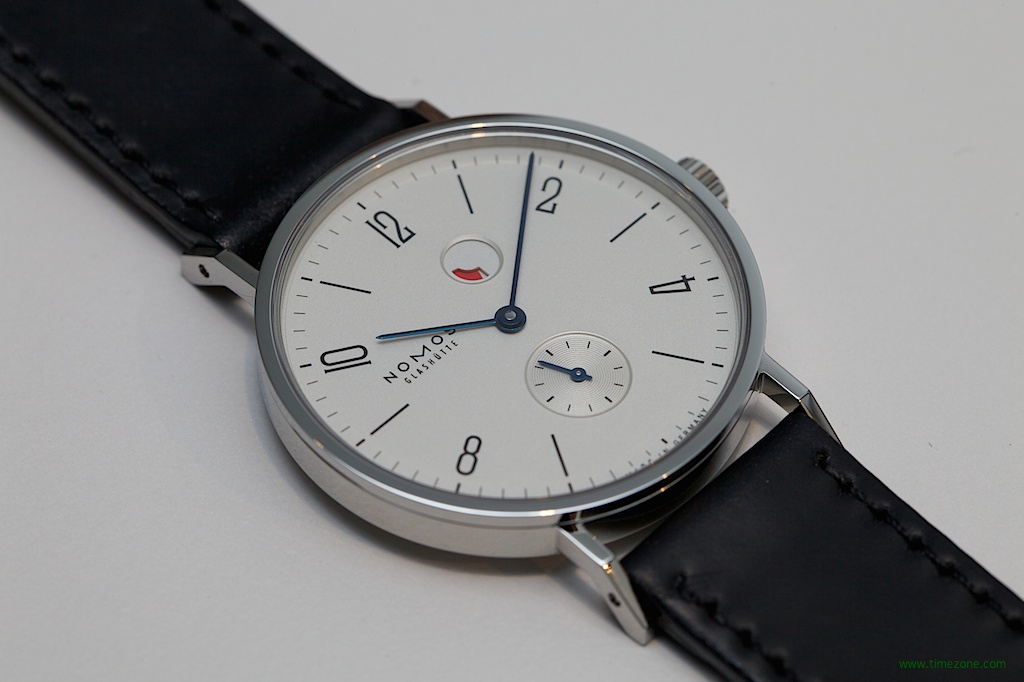
In addition to offering one of the best value propositions out there as far as true manufactures go, Nomos Glashutte also represents a bastion of sensibly sized watches for those with diminutive wrists and/or old-fashioned sensibilities.  At 35mm in diameter, the Tangente is the ideal size for a dress watch, and its 18mm lug width means that there are plenty of after-market options beyond the admittedly excellent shell cordovan strap that it comes with.  Its austere indices and numbering are, in my opinion, a quintessential expression of the Bauhaus aesthetic, and its blued hands - true blued hands, achieved through chemical processes that occur during heat treatment - match that aesthetic perfectly.

In retrospect, the power reserve indicator that I specifically purchased the Gangreserve for may actually be the weakest link in that particular Tangente's chain.  While useful in keeping the watch wound, it does break up the otherwise seamlessly sleek aesthetic that the basic Tangente model achieves so effortlessly.  In addition, it increases the cost of servicing substantially over the basic Alpha movement.  If I were to redo my purchase, I would likely go with the basic Tangente model - albeit with the same exhibition case back that I enjoyed in the Gangreserve version.

Whether or not the Tangente is for you likely falls to how you answer the following three questions:

First, are you OK with - or perhaps even prefer - a manual wind movement?  There can a certain pleasure associated with the daily ritual of winding a watch by hand, and if that tableau appeals to you, then the Tangente may be right up your alley.


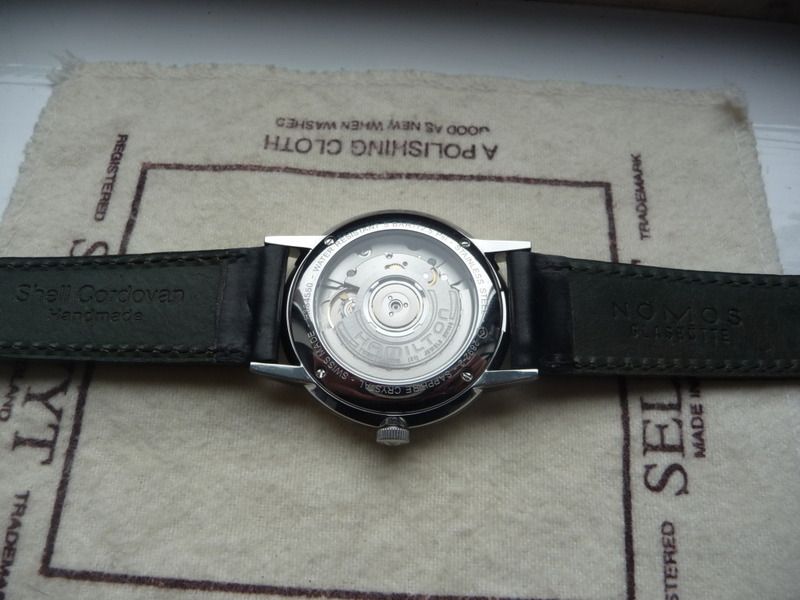
(And if not, the new Tangente Automatik with the automatic  DUW 3001 movement may be the perfect alternative.  Just look at how the DUW 3001 fills up the 35mm case back!)

Second, do you like the way that dress or vintage sized watches look on your wrist?  Nomos's Tangente intentionally bucks the modern trend toward bigger and more substantial wristwatches, which can either be a welcome respite or an unwanted anachronism, depending on what range of watch sizes you find look best on your wrist.

Finally, perhaps the most important question is this: how much does the Bauhaus aesthetic appeal to you?  Is it attractive enough for you to see yourself wearing a watch in that style as your daily wearer, or in lieu of more traditional dress watch styles?  If you're a Bauhaus aficionado, then a Nomos Tangente may very well be your ideal watch.  If you'd prefer more classic, modern, or outlandish designs, then the Tangente probably won't be a viable option as a daily wearer or dress watch stand-in; whether it should still have a place in your watch box depends on the size of your collection and the financial resources you're willing to devote to it.  For me, while I'm a fan of the aesthetic, I'm more partial to more classic designs, such as the Patek Philippe Calatrava for dress watches, or the Rolex Oyster Perpetual when it comes to all-rounder watches that straddle the sporty/dress continuum.

Wednesday, May 20, 2015

Watch Review: Kent Wang Bauhaus v3


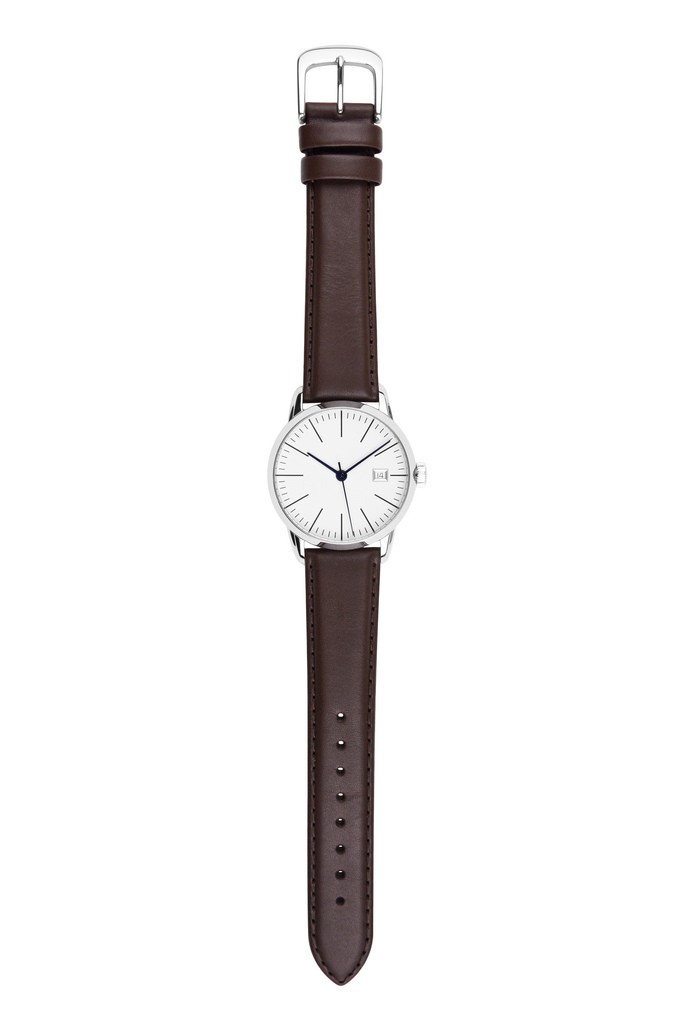
There is something about the Bauhaus aesthetic that is uniquely suited to watch design.  The minimalist, form-is-function philosophy can be especially appealing to those in pursuit - though some might say in vain - of a single watch for every occasion.  For those who want such a watch to not only be as universal as possible, but also affordable and powered by a dependable automatic movement, it's hard to think of a better candidate than Kent Wang's Bauhaus Watch V3.


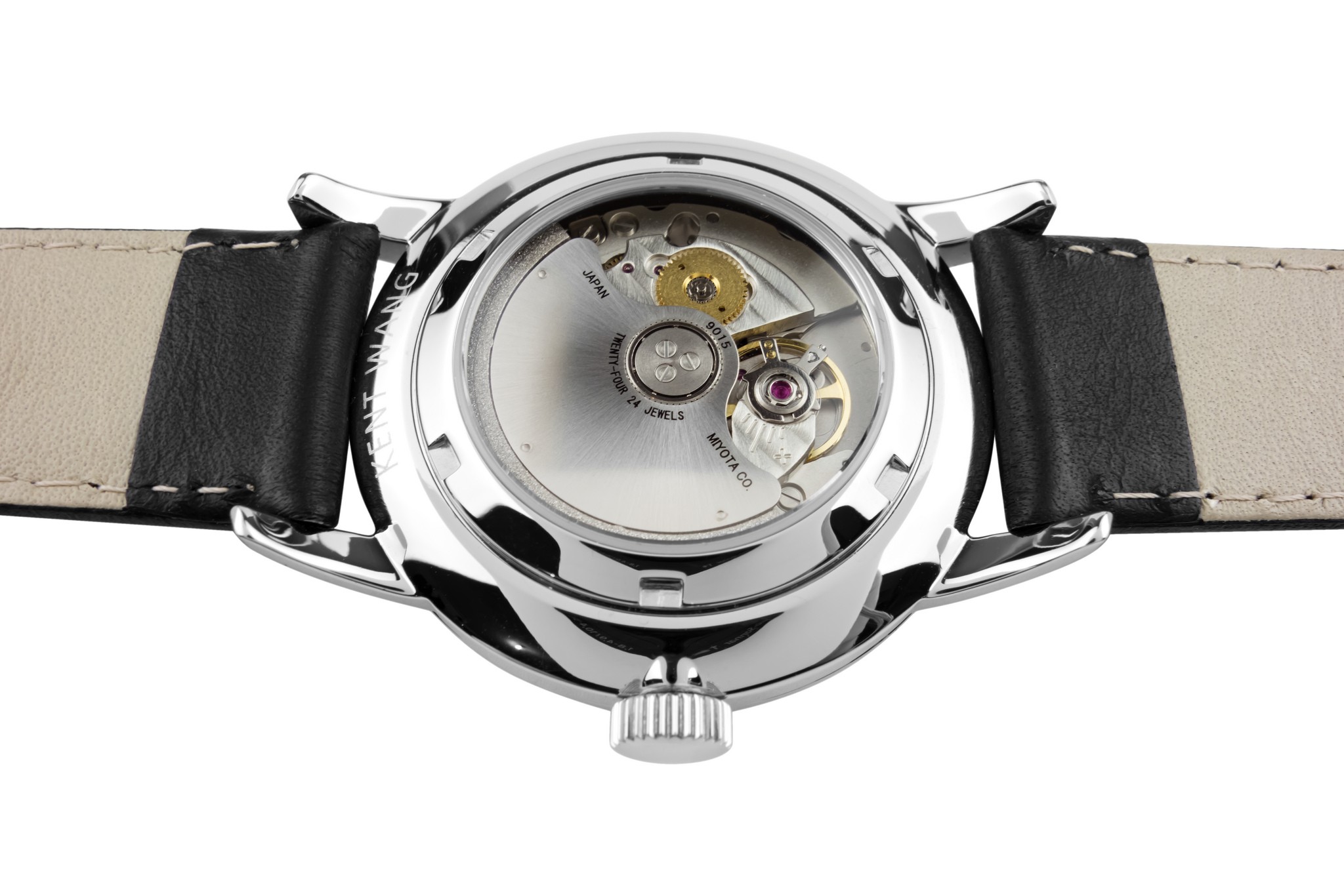
This third iteration of Kent Wang's minimalist watch gets a lot of things right.  At 40mm in diameter (down from the beefier 42mm original), it's poised right at the sweet spot between today's larger watches and the more restrained proportions you'd find in vintage or dedicated dress models.  It features a polished steel case with a scratch resistant sapphire crystal, display case back, and a versatile leather strap that surprised me by managing to fit my 6" wrist on its innermost adjustment hole.  (Most regular-length straps on the market today, or offered standard on men's watches, tend to go only so far as a 6.25" wrist or so.)  As the v3's strap length was, to my understanding, lengthened to accommodate larger wrists up to 8", its ability to accommodate a 2" range in wrist sizes is extremely impressive.  In addition, the Bauhaus's lug width of 20mm means that it is compatible with a wide range of after-market strap options, from NATOs in nylon to unlined straps in shell cordovan.


Of course, it's the dial where this watch earns its Bauhaus moniker.  A simple matte surface with printed (or, in the case of the black version, applied metal) indices form a clean, uncluttered, and utter utilitarian template for telling time.  Eminently readable (especially when contrasted with the white model's blued hands), its only potential flaw - the sameness of the indices could cause one to misread the time if viewed at an off angle - is negated by the date window at 3 o'clock.  The date window's presence is the only real design concession that falls short of the Bauhaus ideal, but it serves enough of a function in utility and improved readability that I think its inclusion adds more to the watch than it detracts.


At under $400 retail (or around $300 if you can catch it during a Massdrop group buy), the Bauhaus V3 offers a tremendous amount of value for its price.  Its Japanese Miyota 9015 movement (upgraded from the Chinese Seagull the original and v2 used) is a solid competitor to the once-ubiquitous ETA 2824-2, and is the workhorse movement that many watch brands turned to after ETA shuttered its supply lines to third parties.  It matches the 2824-2 in virtually every metric except for its winding rotor mechanism, which is uni-directional rather than bi-directional.  While hardly a deal breaker in itself, that fact does mean that it will wind itself a a slightly reduced rate versus a comparable movement with a bi-directional rotor.  It had no difficulty sustaining itself while I used it as my workday wearer, despite my mostly sedentary responsibilities, and if you plan to wear it every day, as I did, it should have no trouble keeping itself wound from day to day.

If you're looking for an extremely versatile yet affordable automatic - perhaps as your introduction to automatic watches in general - Kent Wang's Bauhaus v3 watch is an excellent choice.

Monday, December 15, 2014

Watch Review: Marathon TSAR Medium Diver's Quartz 36mm


I've always been a fan of quartz movements when it comes to diver's watches, or really any watch with a screw-down crown.  The more the screw-down mechanism is utilized, the more likely it is to fail, and depending on the watch and precise nature of the failure, might require replacement of the entire watch case.  This makes low-maintenance quartz movements the functional ideal for watches that employ screw-down crowns for their needed water resistance, as they are accurate enough to minimize the number of times you'd have to access the crown to the end of non-31-day months and the occasional, every-other-year battery change.

Actually finding a full-fledged diver's watch (meaning 300m water resistance) with a quartz movement these days, however, can be a difficult task, further compounded if you're looking for a watch that would look reasonable on a smaller (say sub-7") wrist.  42mm is the threshold for reasonableness for my 6" wrist, and sub-42mm options are very, very hard to come by.

Marathon's original TSAR (short for for "Tactical Search And Rescue"), a solid tool watch noted for its contracts for and use by government agencies, barely fit the bill at around 42mm, though its 13.5mm thickness keeps it at the very cusp of feasibility.  I briefly owned one that I acquired on sale from Top Spec U.S., one of Marathon's authorized dealers, but in the end it was just a little too big and chunky for my needs.


Having once owned a Rolex Explorer I 114270 and an Omega Seamaster Pro 2253.80, I've long held 36mm as perhaps the perfect size for someone with a wrist as diminutive as mine.  The Seamaster in particular was a strong contender for a lifelong diver's watch, but the demands its mechanical movement placed on its screw-down crown was simply too much for my admittedly near-OCD comfort levels.  I considered its equally discontinued quartz-movement-powered doppelganger, the 2263,80, but couldn't bring myself to spend well over $1000 on a run-of-the-mill Swiss quartz.  

Marathon surprised many watch commentators with the introduction of a "medium" version of its hallowed TSAR, especially in this day and age where the trend of bigger and bulkier watch sizes is showing no signs of slowing down.  Their choice of a 36mm diameter seems audacious in a market where 38mm is already considered small, but not all that surprising, since the difference between 36mm and 42mm is the same 6mm that separates the TSAR (42mm) and its larger brother, the JSAR (48mm).  It seems clear that Marathon intends to offer a version of its Search-and-Rescue diver's watch for consumers spanning the entire spectrum of wrist sizes.


Besides being smaller and slightly less thick (12.5" versus the original 13.5"), the TSAR Medium brings the same feature set as the original: a high-torque ETA F06 Quartz with date display and end-of-life indicator (ticking at multiple-second intervals, rather than per-second), 300m water resistance, tritium tube illumination on its hour indices and hour and minute hands, and a chunky and highly visible diver's bezel with a solid ratcheting motion.  It trades the original's 20mm lug width (and it's virtually endless stream of after-market compatible strap and bracelet options) for the slightly less varied but still highly versatile 18mm, which looks better proportioned to its smaller diameter.

Like all Marathon's diver's watches, the TSAR Medium comes on a rubber strap, though a redesigned one that features half-punched strap holes, allowing the user to punch through only the one they use in order to give the strap a more streamlined appearance.  I'm pleased to say that, while the rubber strap on the original TSAR was too long to accommodate a 6" wrist, even at the innermost strap hole, the strap on the Medium just makes the grade at the innermost position.  So 6"-wristers out there needed shell out for the matching bracelet just to find a comfortable fit.


But while the bracelet is hardly necessary, it's highly recommended.  It completes the TSAR look in a way that a rubber strap never could, and offers a nice nod to the TSAR's government-contracted roots with an engraved U.S. Seal on the clasp.  The dual-screw system does make resizing the bracelet a bit more challenging - but not impossible - so if you're wary of damaging the bracelet in the attempt, it's probably best to seek out a qualified watch professional to do the adjustment.  For those fearless enough to try it on their own, I've managed the deed with two flat-head screwdrivers of the same size, with scotch tape securing the watch to the work surface to prevent it from wriggling out of position.

At just under $500 (and just over $650 with bracelet), the TSAR Medium is admittedly pricey for a quartz watch.  But if you like your watches reasonably sized and agree that the ease and accuracy of quartz is best suited to diver's watches, you'd be hard pressed to find a better in-production option than Marathon's TSAR Medium.

Case: Brushed Steel
Movement: High-Torque ETA F06 Quartz
Dial: Black
Lume: Tritium Tube
Crystal: Sapphire
Strap: Rubber (steel bracelet available)
Water Resistance: 300m
Dimensions: 36 x 43.5mm
Thickness: 12.5mm
Lug Width: 18mm
Price: $495 (+ $180 for bracelet)

Monday, December 1, 2014

Watch Review: Seiko Railroad Pocket Watch SVBR001

Image courtesy of Seiya Japan, a well-respected exporter of JDM watches.
I've had a fascination with pocket watches from the moment I first laid eyes on one.  While anachronisms have always appealed to me in general, there is something intrinsically cultured and appealing about pulling a watch from your pocket to check the time.  While the wristwatch largely replaced the pocket watch that used to occupy a place of prominence in every gentleman's getup (and has, in turn, been functionally supplanted by the timekeeping function inherent to cellphones), it remains the only traditionally acceptable timepiece to wear with all but the most formal attire.  It is for this reason that I reserve room in my watch collection for a pair of pocket watches, one mechanical, one quartz, to fill in during occasions where sartorial dictates would inveigh against wrist-borne timepieces.

The Seiko Railroad Pocket Watch (SVBR001) was one of the few purchases I'd planned well in advance of my last trip to Japan.  It's a perfect example of a contemporary watch designed firmly in the aesthetic of vintage timepieces, affording you the convenience of a modern quartz movement with the heft and finish of a mostly bygone era at an entirely reasonable price in today's watch market.  At 47mm in diameter, it feels substantial in the hand, and the clear dial markings and well-proportioned hands distinguish it from the more hastily thrown-together designs one often finds in listings of current production pocket watches.  The only modern upgrade I wish it offered is a sapphire crystal; the curved glass that it employs must be consciously babied, since its lupine-style case does not provide the added protection of a hunter-style cover.

Although it comes with an elegant braided lanyard, the SVBR001 is best paired with a genuine watch chain, especially as its aesthetics pair well with the vast majority of vintage offerings.  I use it with a 925 silver single Albert chain from the UK that I acquired on eBay several years ago, but it would be served just as well by a modern double Albert like this one by Ky & Co.  Both watch and chain spend most of their time in a glass pocket watch display case, which I've reviewed previously, that neatly converts any pocket watch into a handsome desk clock.

All in all, unless you're a railroad professional enamored by the classic conductor's aesthetic, the SVBR001 is not an everyday watch.  It is an easily attainable and maintainable callback to a time long gone, that still finds relevance today on the rare social occasions that hearken back to the more refined nuances of yesteryear.

Monday, November 17, 2014

Watch Review: Seiko SARB035

The Seiko SARB series is well-known among watch aficionados as one of the greatest value propositions among entry-level mechanical wristwatches.  It offers a handsome range of watches with a classic, subtly Japanese-influenced aesthetic, and automatic, in-house (thanks to Seiko's vertical integration) movements roughly at the $500 price point.  Only the SARB series' limited availability as a JDM - Japanese Domestic Model - limits its global position as one of the most attractive entry points into mechanical watch collecting.


The SARB035 is a cream-dialed offering that tips the scales at a little over $300, depending on currency conversion rate at the time of purchase.  Its 38mm diameter positions it well between the dress watch and everyday watch categories, as it looks just as at home when paired with a t-shirt and jeans as it does sliding under the cuff of a dress shirt.  The front crystal is sapphire, while the display back is Seiko's proprietary hardlex, meaning that the crystals are unlikely to suffer scratches from daily wear, unless you tend to be rough on your watches while they're off your wrist.

While the SARB035 comes with the dependable, solid-end-link bracelet that defines the SARB line, its 20mm lug width means that you have the widest possible options when it comes to aftermarket straps.  (Contrasted with the extremely hard to find 19mm width you'd have to deal with on most modern Grand Seikos, the SARB035 only looks like an even better choice.)  I opted for a shiny aftermarket cordovan strap that I got at the same Yodobashi Camera where I picked up the SARB035.

The the slightly iridescent cream dial and intricate fraction-of-a-second painted indices really play up a strongly appealing vintage vibe, as does Seiko's font, hands, and applied indices selection.  The watch looks on par with automatics in the several thousand dollar range, and offers similar performance with its 6R15C movement, which offers an impressive 50-hour power reserve and usually performs far more accurately than its rating of +25/-15 secs/day.

Image courtesy WatchUSeek Forums.
 The only thing that might give some buyers pause about the SARB035 or the SARB series in general is the lackluster fine adjustment for the included bracelet.  With only two fine adjustment positions in the clasp and one-size links, I've found myself in the unfortunate position of being in between adjustment sizes for both the SARB035 and SARB045's bracelets.  Too tight is never an option, and I can't abide bracelets that shift up and down the wrist like a bangle, which is why I opted for the aftermarket strap.  A minor annoyance for those who intend to wear this watch with a fine leather strap to complement its vintage vibe, but a potential deal breaker for those who intend to use the bracelet and find themselves stuck between adjustment sizes.

With only that small caveat, the SARB035 is a solid value proposition and great entry point into mechanical watches for those who can gain access to this Japan-only beauty.

Monday, October 7, 2013

Watch Review: Marathon TSAR on U.S. Great Seal Bracelet


Spend enough time on any of the usual watch forums - especially where dive watches are discussed - and sooner or later you'll come across the Marathon Search-and-Rescue series of watches.  Marathon is a Canadian company that supplies Swiss-made watches to the U.S. and Canadian governments, and which has garnered a reputation for solid, purpose-built tool watches for those who value function first, form second.  As previous mainstay tool watches like the Rolex Submariner and the Omega Seamaster venture farther into fashion - some might say "bling" - territory, the backlash against that trend has led some dive watch enthusiasts to seek out the classic tool watch functionality and aesthetic from other sources.

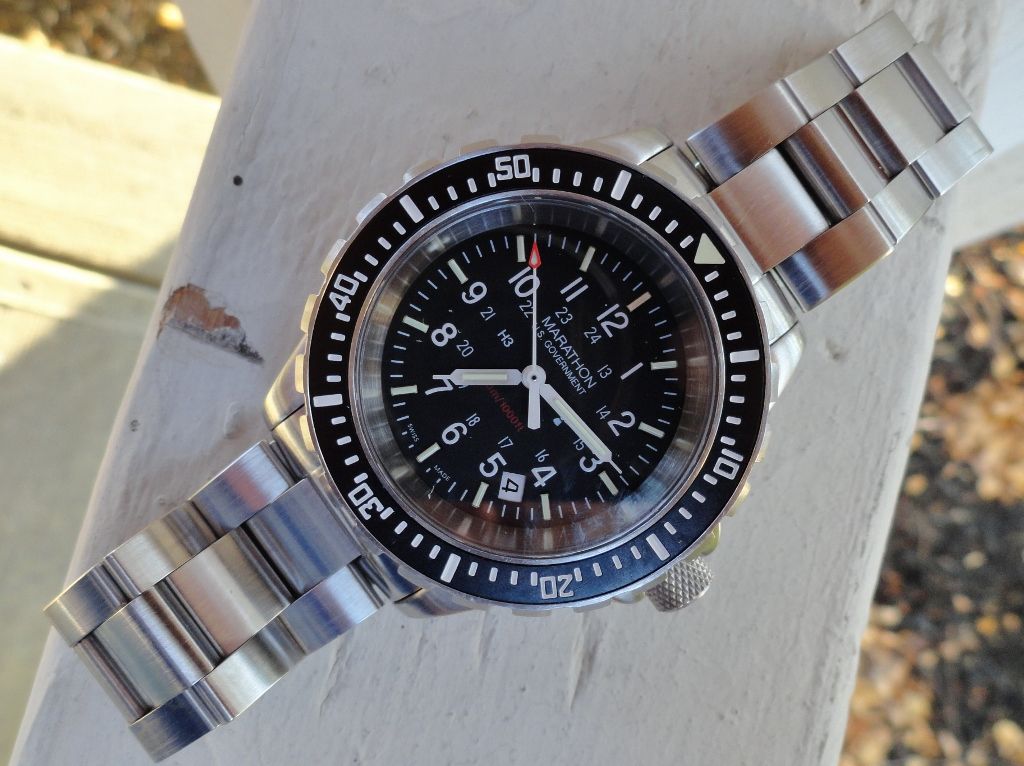
Marathon's SAR series comes in several flavors.  The TSAR is a quartz-powered watch with a sensible 41mm diameter.  The GSAR is its automatic-powered - by an ETA 2824, specifically - doppelganger.  The JSAR is an oversized version at 47mm.   And the CSAR tops out the line as the automatic Valjoux 7750-powered chronograph.

Given the playing field, my choice among Marathon's offerings was an easy one.  The TSAR combines the ruggedness of an ideal dive watch with the better (though not impervious) shock resistance and low maintenance of a quartz movement.  Despite its chunkiness, its 41mm diameter is very restrained in a world of 45mm+ monstrosities.  The TSAR is only available on a rubber strap that - like most "regular" length straps on the market today - proved too long for its innermost hole to accommodate a 6" wrist.  Even had the strap fit, though, I still would have opted to replace it with the very solid matching bracelet that Marathon offers emblazoned with either the U.S. great seal, a U.S. Marines seal, or the Canadian maple leaf.  Given that the TSAR version I picked up features the "U.S. Government" notation usually found on government contract Marathons, I figured the U.S. great seal bracelet would provide a nice counterbalance and round out the tool watch aesthetic of the TSAR.


The TSAR maintains all of the tool watch features that other formerly function-over-form watch models have shed in the pursuit of fashion:  drilled lug holes, a knurled crown, and a diver's bezel that is legible and functional from the full zero to 60 minutes.  The minute hand is just long enough to line up with the minute indices, and the tritium illumination is bright but not obnoxiously so under darkened conditions.

For me, the Achilles' heel of a quartz movement is how the sudden need for a battery replacement can leave you with a dead watch at the most inconvenient times.  The movement employed by the TSAR is one of several I've come across that fends off this contingency by including an end-of-life indicator that, in theory, should cause the movement to advance in 4-second increments when the battery needs changing.  With that mechanism, maintenance of the watch becomes a far easier and predictable proposition than another dime-a-dozen quartz or even a mechanical movement.

Shopping around for the greatest deal available at the time, I snagged the TSAR and its bracelet for $707 all together.  You might be able to find it for less depending on market conditions at the time, or if you are willing to go used and come across a solid example.  How ever you get your hands on it, I highly recommend it.


Monday, September 23, 2013

Watch Review: The Affordable (Under $30) Casio MTP-1239D-2A


Shortly after acquiring the Casio MTP-1183A-2A, I discovered its day-date variant, the MTP-1239D-2A.  I initially dismissed it as I presumed it would be largely the same as the 1183A, but a picture of its bracelet revealed a push-button clasp as opposed to the friction clasp on the 1183A.  The idea that I might be able to swap out the 1183A's friction clasp for a push button made me decide to take the plunge and pick up the 1239D.

When it arrived, the first thing I noticed was the blue of the dial.  While the 1183A's dial is a muted, almost violet shade, the 1239D's is closer to the vibrant blue I've seen in Seiko's SARB series and approaches the "electric" blue of the reference 2253.80 Omega Seamaster I used to own.   Looking at the image above, you might also notice that the positioning of the 12 o'clock indices is slightly more spaced on the 1239D's dial than the 1183A's.  I think it provides stronger proportionality to the entire layout.

The bracelet also yielded interesting differences upon closer inspection.  While virtually identical at first glance to the 1183A bracelet, its links are incompatible.  Moreover, the bracelet's finishing is more of a matte, frosted finish than the brushed finish on the 1183A.  Most surprising however was that the curve of the push-button clasp was less curved than the 1183A's clasp, making the fit much more angular and less appealing on my 6" wrist.  That, coupled with what seems to my eye to be a better, more aesthetically pleasing finish on the 1183A's bracelet, led me to end up choosing the exact opposite combination I intended to when I first acquired the 1239D:  The 1239D's head combined with the 1183A's bracelet.

Because of my watch box rule, the 1183A has been displaced by the 1239D, albeit in a hybridized form.  The assembled package of 1183A bracelet and 1239D watch head costs about $45, which still clocks in at less than the vast majority of watches out there.  And either the date-only 1183A or the day-date 1239D would make a fine single purchase, with the considerations raised above, at $20 and $25, respectively.

Monday, August 19, 2013

Watch Review: Bathys 100 Fathoms Automatic SIlver PVD


I've had an alternating love-hate relationship with Bathys Hawaii for a while now, beginning with when I first laid eyes on their Aquaculture model back in 2009 (sadly, more than a year too late to have purchased one during its original run).  The notion that I would be able to obtain a mechanical watch from a small company headquartered in the islands where I grew up was high on my priority, and only a combination of supply issues and the comparatively exorbitant brick-and-mortar pricing that Bathys had resorted to at the time prevented me from delving in.  (The base 100 Fathoms, like the one reviewed here, was retailing in stores for nearly $1000.)

I managed to get my hands on a preowned Benthic with mother-of-pearl dial in 2011, but the 44mm diameter was simply too much for my 6" wrist.  It's possible that the long-awaited Bathys bracelet would have salvaged it, but I seized the opportunity to flip the watch when it arose, just before Bathys announced its shift from brick-and-mortar stores back to online retail, along with a $300 price drop for most of their watches.  $695 was a stronger value proposition for the 100 Fathoms auto, but at that point I wanted to try out the quartz version with its big date.  Unfortunately, despite indications from Bathys's founder that the 100F quartzes would be eventually restocked, they have yet to surface in the more than two years since I originally make my inquiry.  (Learning a few months later that the specific Rhonda movement used in the quartzes required manual advancing beyond the non-existent 32 through 39 displays also weakened my enthusiasm.)  When the Bathys bracelet finally came out, I knew I would eventually have to try out a 100F with one attached, but the pricing made it so that the total package would have run close to $900.

A couple of things have changed since then that made me finally decide to take the plunge.  First, the manufacturer of the bracelet has decided to discontinue it and sell off his remaining stock at liquidation prices.  This means that the window for acquiring the bracelet will eventually close.  Second, Bathys has decided to up their game by dropping the price of the 100F auto to $595.  Together with the discounted bracelets, that means that you can pick up the total package for just under $650 - less than the 100F auto alone would have cost you six months ago.  That was enough to coax me into taking the plunge.

I went with the ruthenium dial, Silver PVD version because I figured it would go best with bracelet, which I picked up in both silver and black PVD forms.  Installing the bracelet was a bit more challenging that I anticipated, with some small tweaking required on the end pieces to make the pins line up properly, but once installed the bracelet feels very solid and matches the 100F well.

The 41mm diameter coupled with the large dial is about as big as a watch can be on my wrist without looking ridiculous, and the watch head is about as thick as I'd venture to wear.  Surprisingly, I found myself wondering if I'd made a mistake picking the ruthenium dial over the black, as visibility can be adversely affected depending on the lighting angle.  But what disturbed me the most - and led me to finally decide to return the watch - was that there was milling residue on the chapter ring around the 8 o'clock mark, and a piece of lint a little below the 3 o'clock mark.  These could only really be seen up close, but could be seen with an unassisted eye.  This to my mind is inexcusable in a watch costing several hundred dollars, and necessitated the return.

I considered opting for an exchange with a black-dialed version, but ultimately decided to wait until the vaunted 100F quartz is restocked - hopefully in black PVD - to making my next, and perhaps final, Bathys purchase.  Here's hoping that when I do, the next example is free of the quality control issues I've encountered so far.

Monday, August 12, 2013

Watch Review - Ultra-Affordable Analog: How a $20 Casio MTP-1183A Took On a $2000 Grand Seiko SBGX065 - and Won

(It's the one on the right.)


It's been a few weeks since the Casio MTP-1183A arrived at my doorstep, and I've had sufficient occasion to put it through its proper paces.  From the onset, my goal in acquiring it was unfair:  it was to vie against a quartz Grand Seiko, the previous occupant of the "blue dial" slot in my watch box, a watch selling for literally 100 times its price.  Understandably, this was a contest it would not - and could not - win on raw specifications alone.  It gains or loses up to 15 seconds a month; the Grand Seiko, 10 seconds a year.

The dial is nicely legible, and the blue sunburst tone, while not as deep or reflective as the one on the Grand Seiko, is still impressive given the watch's bare-bones price.  Even more impressive is how well the second hand lines up with the indices - a sticking point that other quartz offerings listed at more than 20 times its price have failed to get right.  (In my watch history, the offender was a $500 Hamilton Ventura, though several comparably priced $20-$30 Timex Weekenders also suffered from a similar letdown.)  The simple hands can be a bit harder to read in certain conditions than the larger and more painstakingly finished ones on the GS, but even the GS hands suffer in low-light situations given their lack of lume, which is more of an aesthetic choice than a deficit of design.

At 38mm in diameter, it is marginally bigger than the GS at 37mm, though the smaller dial size makes the MTP-1183A seems comparatively smaller on the wrist (and somewhat better proportioned on mine).  Lug guards protect the shallow crown and contribute to a slightly more sporty profile, though the MTP-1183A classic enough to fill in as a dress watch if paired with a quality 20mm leather strap.  This, in fact, is where the Casio trumps the GS:  its 20mm lug width allows for far more strap options than the GS's painfully hard-to-find 19mm.  If you're a strap fanatic, the Casio offers far more flexibility.

The folded metal bracelet is serviceable, but nothing to write home about, and easily trumped in comfort and finish by virtually any solid end link bracelet on the market.  I've replaced it with a 20mm Oyster bracelet from Tungchoy Watch.

I bought the Casio on a lark to see how it would compare to the top-of-the-line quartz GS.  It ended up doing so well as a value proposition that it has deposed the GS from its place as the quartz backup in my watch box.

Monday, June 3, 2013

Watch Review: Hamilton Intra-Matic 38mm H38455151


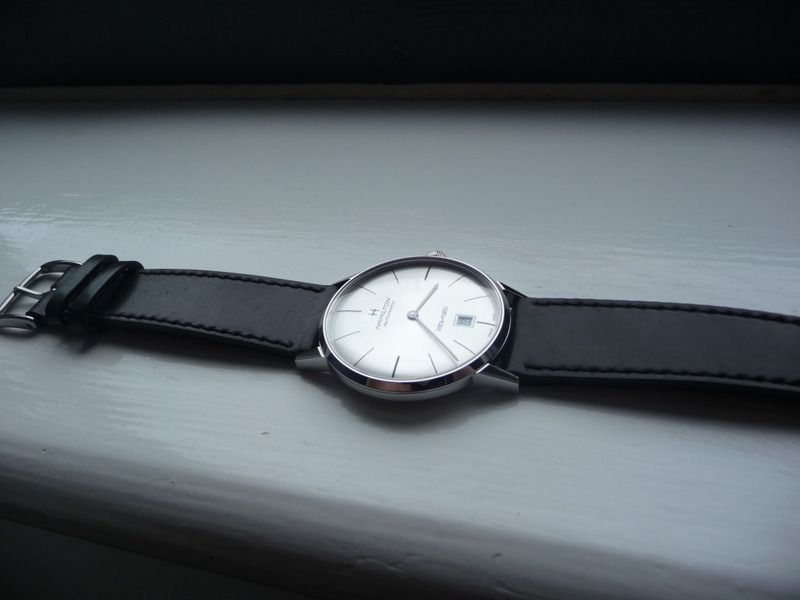
I had thought that I'd managed to kick the watch buying habit after paring down my collection, and especially after a brief Halloween-and-November-themed excursion with the new Seiko Orange Monster SRP309 that ended with a eBay flip.  But a review of the 2012 Hamilton Intra-Matic by James Stacey on A Blog to Watch (formerly A Blog to Read) put the vintage-styled automatic on my radar.  I've bemoaned the trend toward larger case diameters in a previous Watch Primer post, so coming across a freshly released model under the 40mm threshold was a welcome surprise.  The classic styling and silver sunburst dial were immediately attractive, as was the notion of adding an automatic back to my watch box that wouldn't break the bank, and which I would be comfortable wearing daily to work at the courthouse.


With a street price a little over $500, the Intra-Matic is also one of the least expensive options that I know of that is powered by an ETA 2892-2, a slightly thinner and more upscale movement than the ubiquitous ETA 2824.  I've owned two watches in the past powered by this movement or its subsidiary seconds variant - the Omega Seamaster 2253.80, wielding a modified 2892 in its Caliber 1200, and the Xetum Tyndall, employing an ETA 2895, which is the 2892's subsidiary seconds counterpart.  Both came in well above the $1000 mark, so the opportunity to pick up a 2892-powered model with bracelet for less than $600 was too good to pass up.

I found the 38mm case well proportioned for a 6" wrist, the sweet spot for which seems to reside somewhere between 34mm and 38mm.  The dial is preeminently legible, such that it is readable even under low light conditions despite having no applied lume.  I opted for the bracelet version because I suspected the standard-length strap would prove too long for my wrist, and had planned to use a spare black Nomos shell cordovan strap instead.  The watch looks very good combined with the black shell cordovan, but I eventually opted to return it to its stock bracelet, in part so the OCD part of me wouldn't be tempted to swap out the strap for its brown shell cordovan counterpart every time I wore a brown belt and shoes.  While the bracelet tends to make the gorgeous dial blend more into the rest of the watch, the contrast of a black strap really draws attention to it.

Timekeeping on my Intra-Matic has been superb, with less than a minute gained in the several months I've been wearing the watch as a weekday wearer.  The only functional quirk is, regrettably design-based:  the juxtaposition of a hours-and-minutes-only dial with a date display.  Even after several watches successfully weaned me from my fixation with minute markers - the Hamilton Ventura - and second hands - the Citizen Stiletto - the date display would, under normal circumstances, have been a deal breaker.  But the lack of a screw-down crown coupled with my professional responsibilities having made knowing the date at a glance a very welcome convenience, pushed me to take a chance on the Intra-Matic.  I'm very glad that I did.  While I still prefer dateless models in general, the Intra-Matic is a watch that I'd be happy to wear day in and day out for the indefinite future.

Wednesday, December 21, 2011

Watch Review: Timex Weekender T2N654KW

Timex Weekender T2N654KW with royal blue NATO strap.

It's been just about a week since the Timex Weekender arrived in the mail, so I think I've had enough time to render a verdict:

It's the best $30 watch your money can buy today.

Admittedly, the $30 caveat is a sizable one.  And if you're going for as many functions as you can pack on your wrist, Casio offers digitals with far more features.  But in terms of classic style, versatility, and time-telling performance, it's hard to beat the Weekender.

At 40mm in diameter, it's poised right at the transition point between dressier midsized offerings and the larger sports watches that have gained a popular following in recent years.  The case is stainless steel backed, primarily brass with a chrome coating.  Only time will tell how well it holds up to everyday wear and tear, but I suspect it will gain a nice patina if/when the brass begins to show through.  The standard 20mm lug width means you have a wide array of aftermarket strap options, allowing you to dress up the watch with a black leather band - so accessorized, it wouldn't look out of place under a suit sleeve.  But the Weekender really shines when accompanied by a NATO-style strap.  The navy-with-grey-stripe strap that came with this model is really one of the most versatile I've seen, even as far as aftermarket NATOs go, hedging the line between subdued and sporty the way the stripped "Bond" NATO tends to.  I've opted for a royal blue traditional three-band NATO that I picked up on eBay for $10, which treads more on the sporty side of the equation, but still suits the watch to a T.

Timekeeping has been exactly what you'd expect from a quartz movement, with no noticeable deviation in my week's worth of ownership.  The lack of lume on the dial or watch hands is made irrelevant by the integration of Timex's INDIGLO technology, which uses the same electro-luminescent backlighting you'd find in a digital watch to light up the watch's face when you press the crown.  It's an elegant and interesting solution for a battery-operated analog watch.  The only complication is, as I understand it, endemic to Timex watches: their quartz movements produce a noticeable ticking sound.  It may be a conscious feature, an extension of Timex's "Takes a licking, keeps on ticking" motto.  And I've had vintage mechanical movements that tick louder, and the frequency is once-per-second - which corresponds to the movements of the second hand - so I hardly notice it even in silent environs.  But other owners have been put off by the sound, so if you're sensitive to rhythmic noises or prefer complete silence when you concentrate, this may not be the watch for you.

Otherwise, the Timex Weekender T2N654KW has assumed the role of go-to watch in my watch box, and has fulfilled that role admirably so far.  Definitely worth the meager investment if you're looking for an inexpensive yet versatile analog watch.

Monday, October 31, 2011

Watch Review: Casio G-Shock G5600CC-2 & NaNoWriMo Hiatus


The Casio G-Shock G5600CC-w is a 2011 update to the venerable G5600 series, which features an iridescent dark blue resin shell and strap and a blue negative LCD display.  It measures 43mm wide, making it one of the most reasonably sized G-Shocks on the market - which makes sense, as this model was designed to be unisex.  It features Tough Solar technology for recharging its battery by light (both sunlight and artificial light works, though the former is, of course, far more effective), multiple GMT settings for easy shifting between timezones, and the standard alarm, chronograph, and timer functions you'd find on almost any G-Shock.  The real draw here is the unique color of the watch and its negative LCD display, and if you're a big fan of blue, like me, then you'll definitely be satisfied here.

At the same time, under normal lighting conditions (the pictures here are all closeups with flash to highlight the iridescent nature of the blue resin), the watch's color appears navy blue, almost passing for black at the most cursory glance.  That makes it possible to achieve a unique balance with this model that most other G-Shocks fail to do: be both flashy and understated at the same time.  The casual passerby will probably assume it's the same uniform black G-Shock (as most progenitor G5600s are) that you most often find in the wild, though those who examine it more closely will be rewarded by its more unique attributes.


The biggest factor holding me back from purchasing the G5600CC-2 was whether the strap would accommodate my 6-inch wrist.  Most normal-length straps are a notch or two too big for me, which has been a continual problem as I've shopped around for strap options.   I'm happy to say that the G5600CC-2 fits my wrist on its 3rd shortest hole, and as its extra-long strap is studded with holes along most of its length, I'd have to assume it would accommodate wrists of virtually any size.


Despite G-Shock's reputation for putting out watches with pie pan-sized faces, the G5600CC-2 strikes a good balance.  At 43mm, it's on the larger size of my watch box, but it looks well proportioned on the wrist.  The only downside to its one-size-fits-all strap is that a good amount of it will be folded around on smaller wrists.  It's not too much of a problem on a digital sports watch like this, but still something to consider:


The Casio G-Shock G5600CC-2 retails for $120, but you can (as I did) find it online for much less.  Amazon carries it, along with a wide variety of G-Shocks, including another G5600 series model, the G5600CC-3D, which features a vibrant green case and green positive LCD display.


*

On a side note, updates may be sparser in November as I will be participating in NaNoWriMo 2011.  For more information, or to keep track of my progress in the event, stay tuned to updates on Fictional Matters!