Showing posts with label Watches I'm Wearing. Show all posts

Monday, December 1, 2014

Watch Review: Seiko Railroad Pocket Watch SVBR001

Image courtesy of Seiya Japan, a well-respected exporter of JDM watches.
I've had a fascination with pocket watches from the moment I first laid eyes on one.  While anachronisms have always appealed to me in general, there is something intrinsically cultured and appealing about pulling a watch from your pocket to check the time.  While the wristwatch largely replaced the pocket watch that used to occupy a place of prominence in every gentleman's getup (and has, in turn, been functionally supplanted by the timekeeping function inherent to cellphones), it remains the only traditionally acceptable timepiece to wear with all but the most formal attire.  It is for this reason that I reserve room in my watch collection for a pair of pocket watches, one mechanical, one quartz, to fill in during occasions where sartorial dictates would inveigh against wrist-borne timepieces.

The Seiko Railroad Pocket Watch (SVBR001) was one of the few purchases I'd planned well in advance of my last trip to Japan.  It's a perfect example of a contemporary watch designed firmly in the aesthetic of vintage timepieces, affording you the convenience of a modern quartz movement with the heft and finish of a mostly bygone era at an entirely reasonable price in today's watch market.  At 47mm in diameter, it feels substantial in the hand, and the clear dial markings and well-proportioned hands distinguish it from the more hastily thrown-together designs one often finds in listings of current production pocket watches.  The only modern upgrade I wish it offered is a sapphire crystal; the curved glass that it employs must be consciously babied, since its lupine-style case does not provide the added protection of a hunter-style cover.

Although it comes with an elegant braided lanyard, the SVBR001 is best paired with a genuine watch chain, especially as its aesthetics pair well with the vast majority of vintage offerings.  I use it with a 925 silver single Albert chain from the UK that I acquired on eBay several years ago, but it would be served just as well by a modern double Albert like this one by Ky & Co.  Both watch and chain spend most of their time in a glass pocket watch display case, which I've reviewed previously, that neatly converts any pocket watch into a handsome desk clock.

All in all, unless you're a railroad professional enamored by the classic conductor's aesthetic, the SVBR001 is not an everyday watch.  It is an easily attainable and maintainable callback to a time long gone, that still finds relevance today on the rare social occasions that hearken back to the more refined nuances of yesteryear.

Monday, November 3, 2014

Watch Review: Affordable Mechanicals: sub-$300 Range: Hamilton Field Khaki Hand Wind H69419363 Officer Handwinding


With the entry point of Swiss-made mechanical watches approaching - and often well exceeding - the $1000, many newcomers to realm of the watch enthusiasts must limit themselves to Asian-made or vintage Swiss models if their budget only goes as high as a few hundred dollars.  For those individuals, the entry-level brands of the Swatch Group, such as Tissot and Hamilton, offer some of the best value propositions on the market today.

The watch on review today is perhaps the finest and least expensive example in Hamilton's present collection:  the Field Khaki Hand Wind (currently listed as the Officer Handwinding on Hamilton's website), reference number H69419363.  Its simple three-hand design reflects a functionalist and spartan outlook that meshes well with its military aesthetic.  At 38mm in diameter, it is well positioned as an understated timepiece that could be easily dressed up with a leather strap or matching bracelet (more on the latter below).  Its 20mm lug width ensures that it is compatible with a wide range of aftermarket straps, and the drilled lug holes are an increasingly rarefied feature that makes strap changes a breeze and further cements the watch's function-first aesthetic.  The watch comes in a black dial and an olive drab dial, the latter of which can appear black or grey depending on the light and surroundings.  

Notable at this price point is the watch's domed sapphire crystal, whose charming lack of anti-reflective coating makes it evoke the vintage charm of actual military watches that used plastic or plexiglass crystals, while offering the modern scratch resistance of sapphire.  Its movement is an ETA 2804-2, which is the most recent manual-wind version of ETA's workhorse 28XX lines of movements.  For those looking to understand the anachronistic appeal of a mechanical watch in a world where every cellphone can tell you the time, the combination of sweeping seconds hand and daily ritual of winding the watch to maintain its 38-hour power reserve offers the full experience at perhaps the lowest price attainable for a Swiss mechanical watch.

As pictured above, I opted to dress up the watch with its matching bracelet (reference number H605.694.101, available direct from Hamilton for $114 plus shipping at the time of writing).  I found that the solid-end-link bracelet really completes the watch by matching seamlessly with its satin metal finish, and as versatile as the watch is with a wide range of straps, uniting the watch with its bracelet makes it feel suddenly whole.

The Hamilton Field Khaki Hand Wind H69419363 (aka Officer Handwinding) is available on Amazon for less than $300.

Specifications:
Diameter: 38mm
Lug Width: 20mm
Dial Color: Olive Drab
Crystal: Sapphire
Movement: ETA 2804-2 (manual wind, approximately 38-hour power reserve)
Bracelet: H605.694.101 ($114 + shipping direct from Hamilton)

Recommendation:  If you're a fan of minimalism, military aesthetics, handwound movements, and perhaps the best bang-for-buck current production Swiss timepiece on the market today, do yourself a favor and pick up the H69419363.

Monday, June 3, 2013

Watch Review: Hamilton Intra-Matic 38mm H38455151


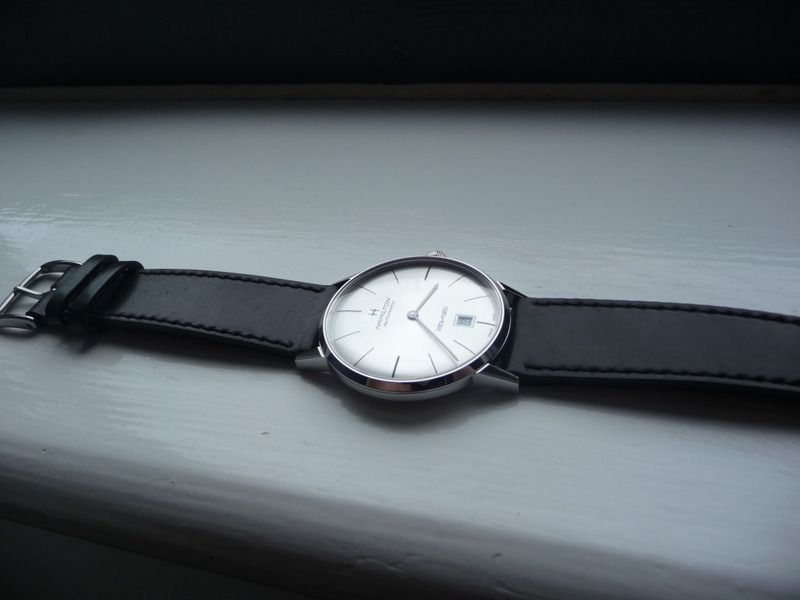
I had thought that I'd managed to kick the watch buying habit after paring down my collection, and especially after a brief Halloween-and-November-themed excursion with the new Seiko Orange Monster SRP309 that ended with a eBay flip.  But a review of the 2012 Hamilton Intra-Matic by James Stacey on A Blog to Watch (formerly A Blog to Read) put the vintage-styled automatic on my radar.  I've bemoaned the trend toward larger case diameters in a previous Watch Primer post, so coming across a freshly released model under the 40mm threshold was a welcome surprise.  The classic styling and silver sunburst dial were immediately attractive, as was the notion of adding an automatic back to my watch box that wouldn't break the bank, and which I would be comfortable wearing daily to work at the courthouse.


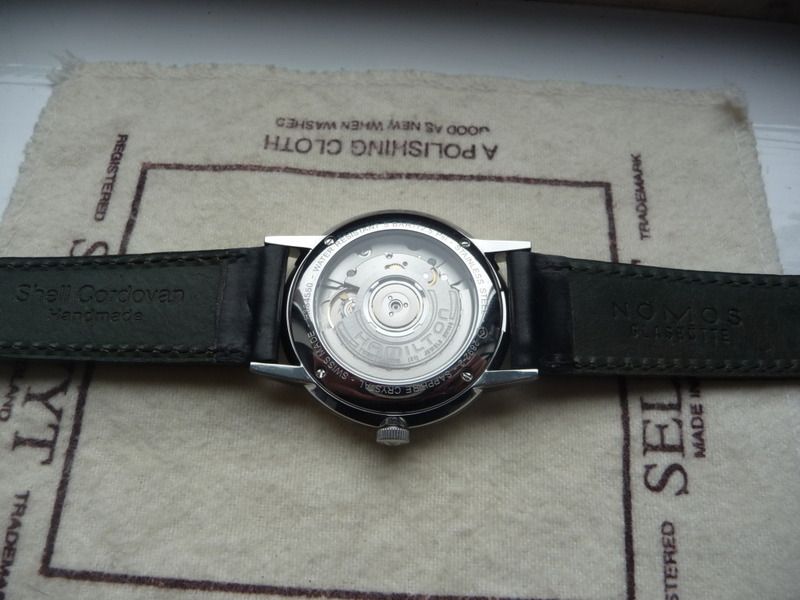
With a street price a little over $500, the Intra-Matic is also one of the least expensive options that I know of that is powered by an ETA 2892-2, a slightly thinner and more upscale movement than the ubiquitous ETA 2824.  I've owned two watches in the past powered by this movement or its subsidiary seconds variant - the Omega Seamaster 2253.80, wielding a modified 2892 in its Caliber 1200, and the Xetum Tyndall, employing an ETA 2895, which is the 2892's subsidiary seconds counterpart.  Both came in well above the $1000 mark, so the opportunity to pick up a 2892-powered model with bracelet for less than $600 was too good to pass up.

I found the 38mm case well proportioned for a 6" wrist, the sweet spot for which seems to reside somewhere between 34mm and 38mm.  The dial is preeminently legible, such that it is readable even under low light conditions despite having no applied lume.  I opted for the bracelet version because I suspected the standard-length strap would prove too long for my wrist, and had planned to use a spare black Nomos shell cordovan strap instead.  The watch looks very good combined with the black shell cordovan, but I eventually opted to return it to its stock bracelet, in part so the OCD part of me wouldn't be tempted to swap out the strap for its brown shell cordovan counterpart every time I wore a brown belt and shoes.  While the bracelet tends to make the gorgeous dial blend more into the rest of the watch, the contrast of a black strap really draws attention to it.

Timekeeping on my Intra-Matic has been superb, with less than a minute gained in the several months I've been wearing the watch as a weekday wearer.  The only functional quirk is, regrettably design-based:  the juxtaposition of a hours-and-minutes-only dial with a date display.  Even after several watches successfully weaned me from my fixation with minute markers - the Hamilton Ventura - and second hands - the Citizen Stiletto - the date display would, under normal circumstances, have been a deal breaker.  But the lack of a screw-down crown coupled with my professional responsibilities having made knowing the date at a glance a very welcome convenience, pushed me to take a chance on the Intra-Matic.  I'm very glad that I did.  While I still prefer dateless models in general, the Intra-Matic is a watch that I'd be happy to wear day in and day out for the indefinite future.

Wednesday, September 28, 2011

Watches I'm Wearing: Omega Seamaster 2253.80 "Electric Blue"

Why "Electric Blue" makes all the difference.

The first watch I'm featuring in the "Watches I'm Wearing" series is also one of the most unlikely.  Despite a passing obsession for the quintessential dive watch, the Rolex Submariner (which eventually lost out to the Rolex Explorer I for a place in my watch box), I generally dislike dive watches.  I'm not a diver, and don't like wearing pretensions of being one on my wrist.  Moreover, I've made it a goal in my watch collection to possess no more than one paradigmatic example of a particular brand's offerings, and in a head-to-head contest, no Seamaster (even the 2253.80) could ever best the classic Speedmaster Professional in epitomizing Omega as a brand.  This version of the Seamaster has been discontinued for two to three years - longer than I've been interested in mechanical watches - and even tracking it down proved a challenge that required resorting to a non-authorized (but excellent) dealer.

So how did it end up in my watch box - and on my wrist even as I type this entry?

Its fate is in part a result of the thriving community of users on the Omega brand subforum on WatchUSeek.  It was there that I first learned of this discontinued model and the "electric blue" dial that it and its full-size brother, the 2255.80, even existed.  The color of the dial changes with the kind and angle of light that strikes it; in broad daylight, I don't know of any dial more vibrant.  It is, for lack of a better description, mesmerizing.

As might be gleaned from my choice in color schemes for this blog, my favorite color is blue, and, in turn, my favorite dial color is also blue.  But the tones that we commonly find in blue-dialed watches are often pale or flat looking.  Even the dial color on my Speedmaster Date, the 3212.80, though nice, seemed to leave something to be desired.  The only time I've seen a blue dial and thought, "Yes, that's the exact hue I'm looking for!" is when I laid eyes on an image of the "Electric Blue" Seamaster in broad daylight.

Despite all horological considerations, the fact remains: at least one spot in my watch box will always hold a blue dialed watch.  This incontrovertible fact meant that I had to find a new occupant shortly after selling off the aforementioned Speedy Date.  I selected a 3510.82 Speedmaster Reduced as that replacement - a limited edition Japan-only model with a sunburst blue dial - but inevitable comparisons with the true Speedy Pro left even it's Japan-only allure lacking.  So after flipping the Reduced, I settled on finding a 2253.80, and resolved on ordering one sight unseen from Essential Watches.  It came in pristine condition, and the moment I laid eyes on the dial, I knew I'd found a keeper.

Underneath the case, the Seamaster is powered by the venerable Omega 1120 movement, which is based on the tried-and-true ETA 2892-A2.  The 1120 was used as the basis for the original co-axial movement, the Omega 2500, and is a proven, robust automatic movement.  The 2253.80 is the mid-size version of the Electric Blue, which means that it measures 36.25mm in diameter, positively diminutive by today's popular standards, especially for a dive watch (which now often finds itself in 44m+ territory).  On most wrists (and for most tastes), the full-size 2255.80 with its 41mm diameter probably offers the ideal proportions.  But for my six-inch wrist and preference for smaller watches, the mid-size stands as a rare diver perfectly proportioned for my wrist and sensibilities, with one of the most gorgeous toned dials of all time, to boot.  Since it entered the watch box, it's never had a chance to wind down.  No other automatic or manual wind can claim that distinction, not even the Explorer or the Speedy Pro.

My only criticism?  It would have been nice to have applied hour markers and screwed-in pins rather than friction pins in the bracelet.  Otherwise, this Seamaster is, for me, as close to a perfect watch as they come.

What do you think about the Seamaster 2253.80, the general lack of midsize men's diver watches these days, or blue dials in general?