Showing posts with label In-House. Show all posts

Wednesday, June 3, 2015

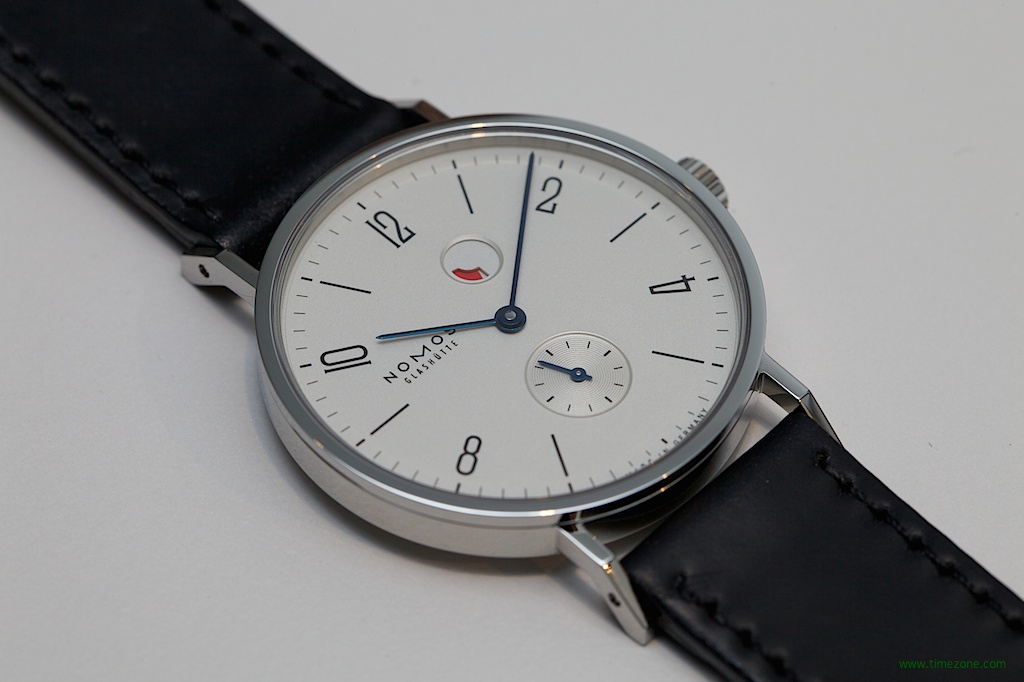
Watch Review: Nomos Glashutte Tangente Gangreserve


In writing last month's Kent Wang Bauhaus v3 watch review, I realized that I never reviewed one of the most paradigmatic Bauhaus-influenced designs out there - and one of the only ones I'm aware of that is available with an in-house movement.  I'm speaking generally of Nomos Glashutte's entire Tangente line, but this review will draw on my experience of the Gangreserve (Power Reserve) model that I acquired several years ago.

In addition to offering one of the best value propositions out there as far as true manufactures go, Nomos Glashutte also represents a bastion of sensibly sized watches for those with diminutive wrists and/or old-fashioned sensibilities.  At 35mm in diameter, the Tangente is the ideal size for a dress watch, and its 18mm lug width means that there are plenty of after-market options beyond the admittedly excellent shell cordovan strap that it comes with.  Its austere indices and numbering are, in my opinion, a quintessential expression of the Bauhaus aesthetic, and its blued hands - true blued hands, achieved through chemical processes that occur during heat treatment - match that aesthetic perfectly.

In retrospect, the power reserve indicator that I specifically purchased the Gangreserve for may actually be the weakest link in that particular Tangente's chain.  While useful in keeping the watch wound, it does break up the otherwise seamlessly sleek aesthetic that the basic Tangente model achieves so effortlessly.  In addition, it increases the cost of servicing substantially over the basic Alpha movement.  If I were to redo my purchase, I would likely go with the basic Tangente model - albeit with the same exhibition case back that I enjoyed in the Gangreserve version.

Whether or not the Tangente is for you likely falls to how you answer the following three questions:

First, are you OK with - or perhaps even prefer - a manual wind movement?  There can a certain pleasure associated with the daily ritual of winding a watch by hand, and if that tableau appeals to you, then the Tangente may be right up your alley.


(And if not, the new Tangente Automatik with the automatic  DUW 3001 movement may be the perfect alternative.  Just look at how the DUW 3001 fills up the 35mm case back!)

Second, do you like the way that dress or vintage sized watches look on your wrist?  Nomos's Tangente intentionally bucks the modern trend toward bigger and more substantial wristwatches, which can either be a welcome respite or an unwanted anachronism, depending on what range of watch sizes you find look best on your wrist.

Finally, perhaps the most important question is this: how much does the Bauhaus aesthetic appeal to you?  Is it attractive enough for you to see yourself wearing a watch in that style as your daily wearer, or in lieu of more traditional dress watch styles?  If you're a Bauhaus aficionado, then a Nomos Tangente may very well be your ideal watch.  If you'd prefer more classic, modern, or outlandish designs, then the Tangente probably won't be a viable option as a daily wearer or dress watch stand-in; whether it should still have a place in your watch box depends on the size of your collection and the financial resources you're willing to devote to it.  For me, while I'm a fan of the aesthetic, I'm more partial to more classic designs, such as the Patek Philippe Calatrava for dress watches, or the Rolex Oyster Perpetual when it comes to all-rounder watches that straddle the sporty/dress continuum.

Thursday, May 24, 2012

Watch Primer: Servicing & Maintenance - The Hidden Cost (and Trouble) of In-House Manufactures

Image Courtesy FLICKR USER ROBERT MÜLLER VIA CREATIVE COMMONS

This installment of the Watch Primer series looks at something that many watch buyers may overlook altogether when selecting a fine mechanical watch: servicing and maintenance.

The vintage watch market abounds with stories of watches that have endured decades of wear and continue to keep accurate time to this day.  Such performance may be attributed to quality of design or manufacturing, but the hidden factor in the longevity of the most dependable vintage watches is periodic servicing, in which movements are cleaned, re-lubricated, and have worn-down components replaced.  Periodic servicing is an essential component in the long-term performance and life of a mechanical watch, as it compensates for the wear that accumulates and ensures that damage isn't exacerbated over longs stretches of time.

Most mechanical watch producers suggest servicing at 2-to-3-year intervals, approximately the same amount of time most quartz movements can go before a suggested battery change.  But in general if a watch is keeping time accurately and without performance concerns, some owners go as long as 5-10 years before bring their watches in for servicing.  A small number even advocate the don't-service-until-it's-broke approach, waiting until something tangible goes wrong with a watch before bring it in to the watchmaker.  My local watchmaker subscribes to the last approach, but personally, I find that it courts with disaster, as allowing lubricants to dry out will increase the wear on the watch's components, inevitably making the eventual service cost that much more.

The cost of servicing depends on a number of factors, including the nature of the work to be done, the number of parts that need replacement, the brand of the watch, and the complication of the movement itself.  A simple regulation - where the timing of the movement is adjusted to reduce the amount of seconds it gains or loses per day - can often be had for around $30, while a full service - which includes disassembly, relubrication, assembly, regulation, and often times case polishing and resealing - can go between $300 to well over $1000 for high-end brands and more complex movements.

Unfortunately, servicing costs are hardly something that a prospective watch buyer will take into account while admiring shiny new models in a display case.  The basic rule would be that the more expensive the watch - which is itself a function of brand, complication, and so on - the more expensive the servicing.  This is even more strongly correlated when it comes to models with in-house manufacture movements, where you might be hard-pressed to find a watchmaker outside of the brand's own servicing department who is familiar enough with the movement to service it.  The monopoly on skilled labor for those movements means that you won't be able to potentially save money on servicing by turning to independent watchmakers, and will likely require you to forgo local workmanship as you send the timepiece to the brand's main repair / servicing center, which, depending on the brand, may require international shipping.

This problem grows exponentially when you have a larger watch collection to tend, which is one reason I've been working steadily to cull down my rotation, which is down to three mechanicals, only one of which is an automatic.  I purpose chose an auto with a ETA-based movement - specifically the Omega 1120, which is based on the venerable 2893-A2 - so that I would have a wide range of serving options beyond sending it to Omega's facility in New Jersey (or, as some WUS users advocate, the main facility in Bienne).  My Speedmaster Professional is a ubiquitous enough model that most watchmakers are familiar with it, and even Omega's servicing cost (reported to be a bit over $400) is very reasonable for a chronograph movement.  But my Nomos is powered by an in-house movement, and will probably have to travel all the way back to Glashutte for its servicing.  

The need for periodic servicing of mechanical watches - along with the absence that accompanies the servicing period - is what leads many collectors to maintain at least one quartz watch in their rotation, as both a grab-and-go option for days when you don't have time to reset and wind up a mechanical watch, and also to tide you over while the mechanicals go through their servicing.  Quartz watches also offer lower maintenance option for both adjusting for lost/gained time and service intervals, as a simple battery change is usually all that is needed to keep them going strong.  And when their movements eventually reach a point where work would need to be done, it's often less expensive to replace the entire movement than to service it to the same level of detail that mechanical watches require.