Monday, July 1, 2013

Watch Primer #14: The Sliding Scale of Mechanical Complications, As Exemplified by Date Functions

Today's Watch Primer entry looks at how complicated the watch on your wrist should be, and the pros and cons of having all those functions at your beck and call.

To start off, what is a complication?  My view on the subject goes back to the most primal function of a wristwatch:  telling time.  Truth be told, a watch needs only an hour hand (or its functional equivalent) to serve its purpose as a watch - and, in fact, some models adhere to that somewhat myopic minimalist ideal.  But the vast majority of watches out there will, at the very least, feature hands for hours and minutes.  In my view, any contrivance designed to provide information beyond those two factors - hours and minutes - is a complication.  Thus, in my view, many of the barest watches come with at least one complication:  namely, a second hand, whether central or subsidiary.

The next most common complication is the date window, which I'd hazard to guess more watches today have than have not.  The perfunctory inclusion of this complication is something of a pet peeve of mine, because it requires tedious resetting if the watch were ever to wind down, or, as occurred between yesterday and today, when a month with thirty days concludes and the date window must be advanced manually from "31" to "1."  Nevertheless, my time working at court - where the date as well as the time is an important consideration - has impressed upon me that a date function can be a useful reminder for a harried mind.  The date window can be accompanied by a day-of-the-week indicator, whose marginal utility is I think outweighed by the added hassle of resetting it along with the date when the watch is wound down.

Additional date-related complications takes you into more rarefied company, starting with the annual calendar, which is designed so that the watch's date displays will only have to be adjusted manually once a year (excepting wind downs).  Often at this point a watch may gain indicators for the month in addition to date and day-of-the-week. The perpetual calendar accounts for the vagaries of the calendar for roughly a century at a time, meaning that, if kept running, the watch will need a servicing long before it requires a date adjustment.  In the most complex perpetuals, a year display may be added on top of everything else.

Somewhere in the play in the joints left between these incrementally more complex date functions is the moon phase complication, which is by its very nature included mostly for show and aesthetics.  I must profess a profound ignorance as to lunar cycles or the utility of tracking them; whenever I see such a complication, I only see a complication in non-watch-related parlance.  The prospect of trying to resync a moon phase to lunar cycles is enough to keep it off of my wrist.

So what do I mean by sliding scale of complications?  The general principle is this:  The more complicated the watch, the less utility you gain from each additional function; at the same time, the cost - in time and money - spent on maintaining those functions increases.  Taking a look at any watchmaker's table of servicing costs will demonstrate that the cost of maintenance scales exponentially as the watch in question grows ever more complicated.  At the same time, by the very nature of those complications, setting and utilizing them becomes an increasingly onerous task as the list of added functions grows longer and longer.  At some point - both in the amount of time you spend attending to it, and the amount of money you spend on keeping it in good working order - I would argue that you begin to cease owning the watch, and the watch starts to own you.

There is a certain purity in being able to pick up a watch, reset the time, give the crown a few turns, strap it to your wrist, and be done with it.  That purity easily translates to ease of use and legibility of an uncluttered dial, and even can make the cost of servicing a far more palatable necessity.  There is no one-size-fits-all answer for how complicated your ideal watch should be.  That is largely a function of your needs, means, and values.  But a guiding principle can be derived from economics' cost-benefit analysis:  You can determine the complexity of your ideal watch where the marginal cost, in both money and effort, of the complication at at least counterbalanced by the marginal benefit the complication provides.  For me personally, this sweet spot occurs where functionality shifts from telling time to marking the date.

Monday, June 24, 2013

Watch Radar: Pebble Smart Watch


A friend who participated in the original KickStarter campaign recently received his Pebble watch in the mail.  His initial impressions are over the moon.  He's especially pleased with the ability to read emails directly on the watch's e-paper screen.  I'm looking forward to asking for his long-term impressions after a few weeks of use.

I held back on participating in the KickStarter campaign in part because I'm usually reluctant to be an early adopter.  My consumer philosophy is to let others work out the initial kinks of product design and wait until a refined version appears on the market.  This tendency compounds when certain technical aspects of a product give me pause.  In the Pebble's case, the things that raised my eyebrow were its seven-day battery life, (presumably) non-sapphire crystal, 22mm band size, and dependancy on iOS / Android compatibility.  The last factor could easily shift from liability to asset, depending on whether the Pebble's connectivity and native app development keeps pace with smartphone operating systems and functionality.  But at a stage where only the earliest backers are just now getting their hands on the product, it's still too early to say how deep the support will run.

Also, in the end, even if the Pebble is as successful and useful as it could be, giving it a place in my watch box would only result in it competing for wrist time with the mechanicals and quartzes that currently vie against each other.  For now, I'm happy to let others serve as the intrepid pioneers for what may very well be the next phase of evolution for the humble wristwatch.  The decades-old technology in the automatic on my wrist suits me just fine.

Monday, June 17, 2013

Watch Primer: Watch Spotting

Image courtesy PhotoBucket user always247


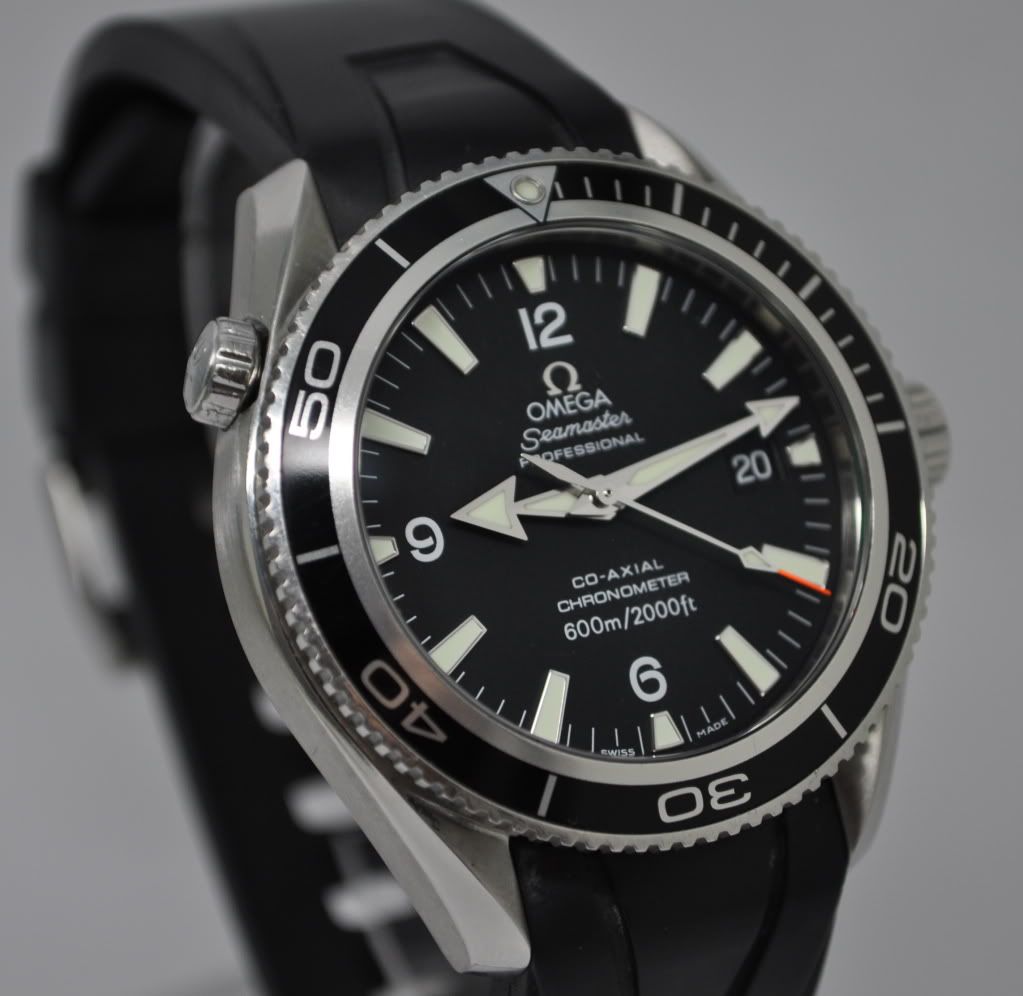
As you journey deeper and deeper into the quagmire that is watch collecting and WISdom, the knowledge that you inevitably pick up along the way (not unlike mud on tires or barnacles on the hull) will lead to you spotting familiar watch models on others' wrists when you're out in public.  In a recent outing with a couple high school friends, I spotted an Omega Seamaster Planet Ocean on one of them.  A few seconds of scrutiny allowed me to determine that it was a 42mm Caliber 2500 model (from the hands, orange numbers on black dial, what appeared to be a painted bezel, and an engraved caseback - which I believe has been replaced by sapphire in the current Caliber 8500s).  I would have asked about it, but we were in mixed company and didn't want to necessarily call attention to what, if purchased new when 2500 POs were still stocked, was a $4000+ watch.  (Ironically, others in our party would later comment on the watch, but focused on its bright orange neoprene strap.)

It's one thing to take note of and remark on watches among friends, but what is the protocol when you spot a familiar watch on a not-so-familiar wrist?  As with most social situations, it's primarily a matter of context.  Crossing paths on the street?  Maybe not.  Waiting in a line?  Maybe.

Personally, unless I can infer from the context or the specs of the watch in question that the person its attached to is another WIS, I tend to take note but not bring it up.  Especially with garden variety Rolexes (Submariners and Datejusts), it's about an even chance that the person wearing it just acquired it because it's a Rolex, and may be largely uninterested - or even put off - by someone who wants to talk about the technical minutiae that WISes tend to obsess over.  I have noticed, however, that a person who engages in other somewhat anachronistic personal items - e.g., fountain pens - are more likely to be interested in the details.

What has your experience been in spotting familiar models on the wrists of passersby?  Have you ever approached a stranger to ask them about their watch?  Let me know in the comments below.


Monday, June 10, 2013

Watch Brand Review: Hamilton


Today's reviewed watch brand occupies an interesting position in the watch world.

Identity

Hamilton began as one of the paragons of the American watchmaking industry, along with others like Elgin and Waltham.  Modern American watchmakers like RGM look to Hamilton as a spiritual predecessor, even using refurbished Hamilton movements in some of their offerings.  Like its peers, however, the American Hamilton fell to the wayside in the mid-20th century, though its name and branding live on as an entry-level brand in the large and powerful Swatch Group.  The economy of scale that Swatch brings to bear coupled with Hamilton's market position means that it represents one of the most inexpensive ways to acquire dependable models powered by solid Swiss movements - particularly after Swatch choose to dwindle the supply of ETA movements to third-parties.  As a result, Hamilton is a logical choice for many looking to inaugurate themselves into the world of Swiss-made mechanical watches.

Design

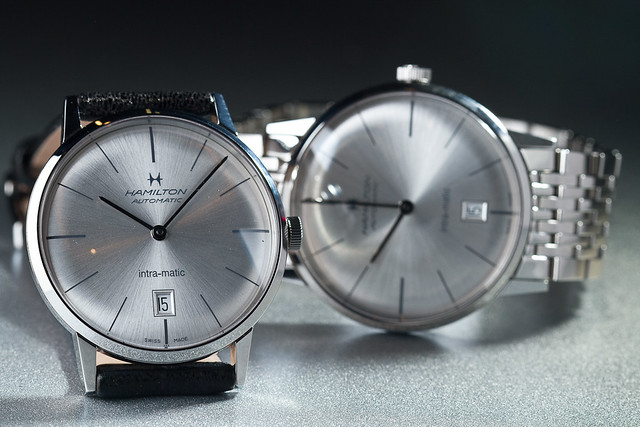
The trade-off for the attractive price points and value ratio lies in the design of many of Hamilton's offerings, which seem at times hopelessly diluted or derivative.  Subtleties are also often determined by the dictates of the underlying movement - the exact opposite of what true manufacturers strive for (albeit with the luxury of price points several orders of magnitude greater than Hamilton's) - so that they appear aesthetically odd or out of place.  There are exceptions; iconic designs like the classic Ventura, which have endured the test of time (even though its original electronic movement has not), and others that draw on Hamilton's history, like the Intra-Matic (though it too sheds its lauded micro-rotor movement for a more run-of-the-mill ETA 2892-2).  But even those examples contain compromises:  the Ventura's dial has a plasticy appearance when viewed close-up, and its pedestrian quartz movement's second hand doesn't line up with its hour marks, while the Intra-Matic's bracelet appears to be one of Hamilton's stock designs, employing friction pins where competing brands might have offered a screw-in system.

Functionality

By and large Hamilton makes up for the lumps it takes for its half-hearted designs in the functionality of its offerings.  As can be expected of watches powered by time-tested workhorse movements, they do what they're supposed to.  The ETA 2892-2 in my Intra-Matic may be one of the most accurate mechanicals ever to grace my watch box, which has included in-house offerings from Nomos and Rolex.  Moreover, there is a certain degree of comfort in the knowledge that, should anything go wrong, the ubiquity of ETA's movements means that any watchmaker worth his salt knows how to handle them, and that replacement parts are readily sourceable.  That's the hidden added cost of being an in-house snob:  the exclusivity of the movement on your wrist means that you have very few options when it needs servicing or repair.  Those limited options mean swallowing a bitterly expensive pill when the time comes.  While this may be a non-issue to those who have the disposable income to expend on five figure - or more - timepieces, those who would have to save to afford them have to factor service costs into the overall calculus of acquisition.  In this way, and for what it's worth, Hamilton occupies the "affordable" quadrant of Swiss mechanical watches.

Conclusion

While Hamilton does offer one of the best value propositions in the realm of Swiss watches, I would offer a word of caution to those who would, as a result of their relative affordability, seek to build a sprawling collection of Hamiltons or similarly priced watches.  One or two can cover bases in a collection that might cost considerably more if a collector were to turn to the offerings of more prestigious brands; but once a collection comprises half a dozen or more watches in the sub-$1000 range, the total amount of money expended could have allowed for the acquisition of a single superlative watch which would likely eclipse those Hamiltons in virtually every respect.  Thus, while Hamilton is a great value introduction to Swiss mechanicals, its offerings alone, I would caution, should not a collection make.

My Pick


This is probably a no-brainer:  it's the Intra-Matic 38mm.  It's on my wrist as I type this review, and unless another value proposition from Hamilton knocks it from its perch (I'm looking at you, Viewmatic Skeleton), it'll continue to hold the "automatic" slot of my watch box for the foreseeable future.

Monday, June 3, 2013

Watch Review: Hamilton Intra-Matic 38mm H38455151


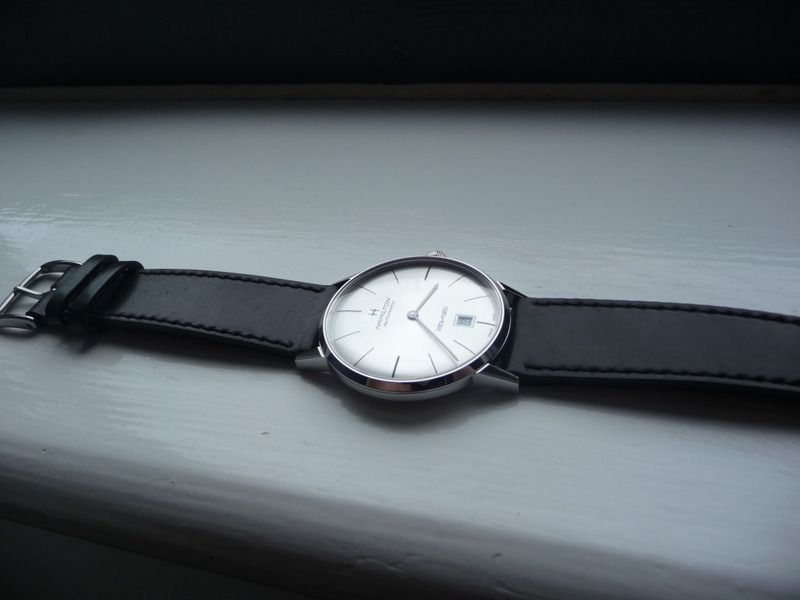
I had thought that I'd managed to kick the watch buying habit after paring down my collection, and especially after a brief Halloween-and-November-themed excursion with the new Seiko Orange Monster SRP309 that ended with a eBay flip.  But a review of the 2012 Hamilton Intra-Matic by James Stacey on A Blog to Watch (formerly A Blog to Read) put the vintage-styled automatic on my radar.  I've bemoaned the trend toward larger case diameters in a previous Watch Primer post, so coming across a freshly released model under the 40mm threshold was a welcome surprise.  The classic styling and silver sunburst dial were immediately attractive, as was the notion of adding an automatic back to my watch box that wouldn't break the bank, and which I would be comfortable wearing daily to work at the courthouse.


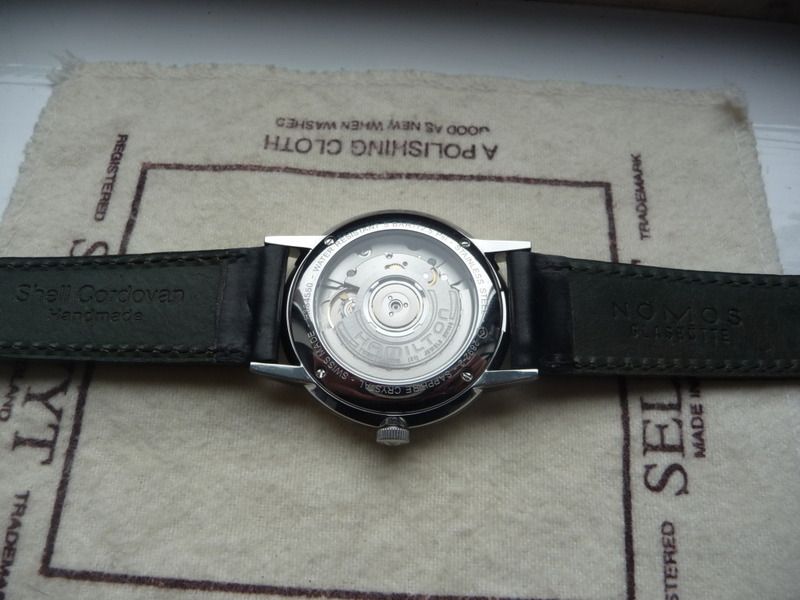
With a street price a little over $500, the Intra-Matic is also one of the least expensive options that I know of that is powered by an ETA 2892-2, a slightly thinner and more upscale movement than the ubiquitous ETA 2824.  I've owned two watches in the past powered by this movement or its subsidiary seconds variant - the Omega Seamaster 2253.80, wielding a modified 2892 in its Caliber 1200, and the Xetum Tyndall, employing an ETA 2895, which is the 2892's subsidiary seconds counterpart.  Both came in well above the $1000 mark, so the opportunity to pick up a 2892-powered model with bracelet for less than $600 was too good to pass up.

I found the 38mm case well proportioned for a 6" wrist, the sweet spot for which seems to reside somewhere between 34mm and 38mm.  The dial is preeminently legible, such that it is readable even under low light conditions despite having no applied lume.  I opted for the bracelet version because I suspected the standard-length strap would prove too long for my wrist, and had planned to use a spare black Nomos shell cordovan strap instead.  The watch looks very good combined with the black shell cordovan, but I eventually opted to return it to its stock bracelet, in part so the OCD part of me wouldn't be tempted to swap out the strap for its brown shell cordovan counterpart every time I wore a brown belt and shoes.  While the bracelet tends to make the gorgeous dial blend more into the rest of the watch, the contrast of a black strap really draws attention to it.

Timekeeping on my Intra-Matic has been superb, with less than a minute gained in the several months I've been wearing the watch as a weekday wearer.  The only functional quirk is, regrettably design-based:  the juxtaposition of a hours-and-minutes-only dial with a date display.  Even after several watches successfully weaned me from my fixation with minute markers - the Hamilton Ventura - and second hands - the Citizen Stiletto - the date display would, under normal circumstances, have been a deal breaker.  But the lack of a screw-down crown coupled with my professional responsibilities having made knowing the date at a glance a very welcome convenience, pushed me to take a chance on the Intra-Matic.  I'm very glad that I did.  While I still prefer dateless models in general, the Intra-Matic is a watch that I'd be happy to wear day in and day out for the indefinite future.

Monday, May 27, 2013

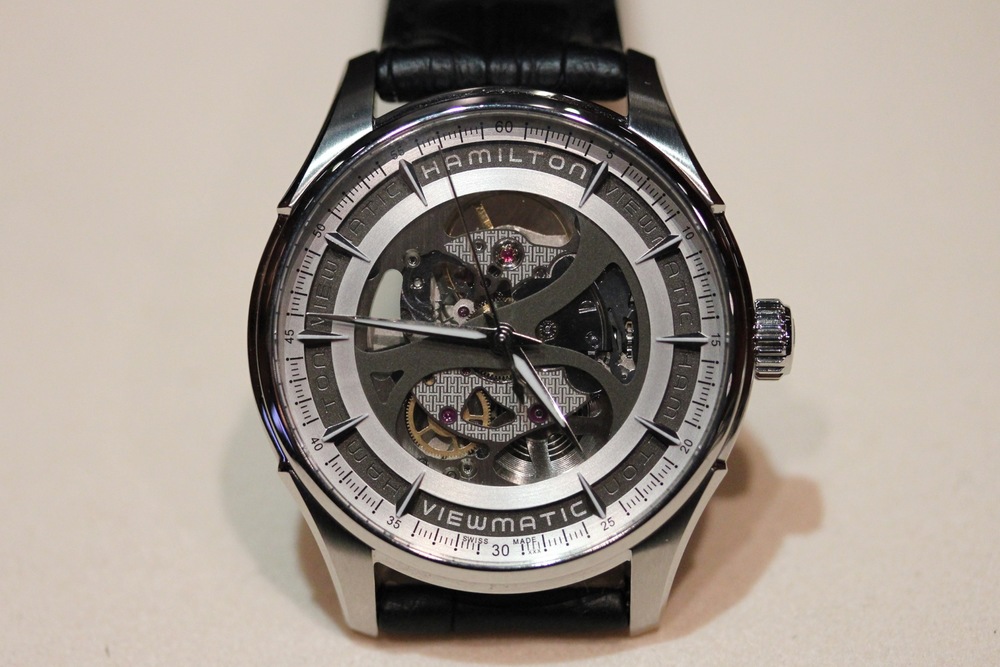
Watch Radar: Hamilton Jazzmaster Viewmatic Skeleton H42555151


Being among the entry-level brands under the aegis of the mighty Swatch Group conglomerate, Hamilton offers one of the strongest value propositions for those interested in Swiss-made mechanical movements - specifically those made by Swatch's subsidiary ETA - in the sub-$1000 price point.  Last year's Hamilton Intra-Matic - featuring an ETA 2892-2 at a street price of just over $500 - is a prime example of the solid finishing and economy of scale that Hamilton can offer budget-minded mechanical watch fans.

The one design that caught my eye - supposedly revealed at BaselWorld 2013, but sneak-peaked by the good folks at Hodinkee in February - is the Jazzmaster Viewmatic Skeleton, reference H42555151.  It represents a rare opportunity to acquire a skeleton movement - an even rarer (though admittedly somewhat contra-purposed) automatic one at that - with the finishing available from a large watch brand at a suggested retail of approximately $1200.  Applying the usual Hamilton street discount, it's likely to become a Swiss-made skeleton model at or below $1000.

Image courtesy Hodinkee.com.
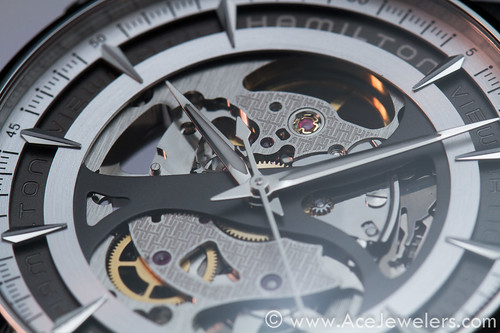
Image courtesy AceJewelers.com.

As can be seen in these close-up images, the dial appears very attractively designed and well-finished for a mass-production model, with many flourishes - like the Hamilton "H" patterning on the movement plate - that can only be achieved economically by a large-scale manufacturer.  The watch is sensibly sized for dress and casual use at 40mm, and satisfies my personal criteria of being time only - avoiding the annoyance of having to reset date or day windows, or the more arcane knowledge required to set moon phase complications (knowledge that I still do not possess).


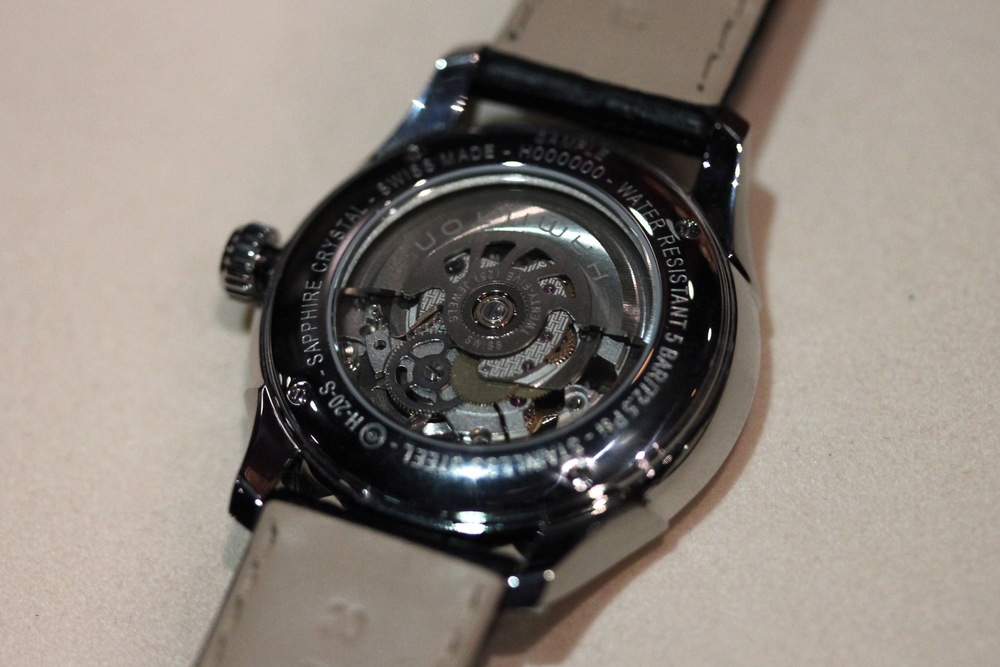
While Hamilton calls the movement a Caliber H-20-S, automatic skeleton; its size relative to the case and rotor design lead me to believe it's a skeletonized form of the ubiquitous ETA 2824, albeit a variant that will be exclusive to Hamilton.  (Another perk of being in the Swatch Group is access to exclusive ETA variations, which other Swatch brands like Longines have also enjoyed.)

For my watch box, the new Viewmatic Skeleton is possibly poised to knock the Intra-Matic from its place as my go-to automatic.  My work responsibilities that make the Intra-Matic's date window a convenient evil will conclude at the end of June, and while I've grown to like the Intra-Matic's hour-and-minute-only hand setup, part of the soul of a mechanical movement does lie in the telltale sweep of its second hand.  Only the comparatively larger size - 36mm to 38mm is really the ideal for my 6" wrist - and potential movement downgrade from a 2892 to 2824 give me pause in considering the switch.  I may have to see the watch in person to make the final call.

Monday, May 6, 2013

Watch Primer #13: Building A Watch Collection

As with any hobby that primarily consists of acquiring manufactured goods (and obsessing over said goods), the sky really can be the limit where watch collecting is concerned.  Where money is no object, one can amass a collection spanning styles, manufacturers, eras, and complications, or price tags rivaling luxury cars and even single-family homes.  Few of us can afford to dedicate such resources to a pass time; but the question is, even if we could, would we want to?

For me (and the purposes of the Watch Primer series), the answer to this question stems from the intrinsic characteristics of the watch itself.  The most elemental is this:

You can only wear one watch at a time.

(I've seen videos of the CEO of Omega, Stephen Urquhart, running around Baselworld with a Planet Ocean strapped to each wrist, but given his position in the industry and the context, I think he provides a fitting exception to prove the rule.)

From this first principle comes a corollary that has direct bearing on the size and disposition of your ideal watch collection:

The amount of wrist time each watch enjoys is inversely proportional to the number of watches in your collection.

This might not matter for those watch enthusiasts who, at least in part, collect watches for the same reason that some people collect coins or stamps - that is, for the collection itself.  For those who make it a point to collect every subtle iteration of a particular model, or the rarest examples across a wide range of brands, actually wearing each and every one of the watches in their collection is merely a secondary perk (or, if they're more focused on maintaining the value and condition of the pieces, an anathema).  But it is my contention that the act and practice of collecting always remains a distant second to the actual use and enjoyment of the watches you own.

Back when my collection threatened to overwhelm my 10-slot watch box, I often found that at least half of my watches remained in the stable for months on end.  A couple saw alternating but occasionally infrequent use, while one watch - usually an automatic - enjoyed go-to watch status.  Among those watches perennially confined to the stable was the Speedy Pro - the eventual winner of my "only watch" category - and every time I reach into the box for another model, I would feel a slight pang of guilt at leaving it behind.  Even now, with my collection pared down to four, two of them - the quartz "backup" and "beater" contingent, comprised of a Grand Seiko and a Casio ProTrek - see very infrequent use.  If I weren't so attached to the notion of having a quartz "backup" dress watch and a "backup" chronograph, I could probably stand to pare down those two as well.

The most important thing is to acquire watches that you would be comfortable putting on day in, day out, for the indefinite future.  This determination is to a large degree dependent on context; if your work days see you often donning a suit, then a dress or dressy sports watch would be appropriate.  If your work is more active and less formal, a more casual and rugged watch may be better suited.  The other half depends on your own aesthetic sense - your propensity or disinclination for certain colors, features, or design elements.  Sometimes, the context and aesthetics force a compromise:  my current work-day watch, a Hamilton Intra-Matic 38mm, deviates from my minimalist aesthetic preference with a date window, which, for the purposes of the court documents I regularly deal with, has proven to be a necessity.