Monday, November 17, 2014

Watch Review: Seiko SARB035

The Seiko SARB series is well-known among watch aficionados as one of the greatest value propositions among entry-level mechanical wristwatches.  It offers a handsome range of watches with a classic, subtly Japanese-influenced aesthetic, and automatic, in-house (thanks to Seiko's vertical integration) movements roughly at the $500 price point.  Only the SARB series' limited availability as a JDM - Japanese Domestic Model - limits its global position as one of the most attractive entry points into mechanical watch collecting.


The SARB035 is a cream-dialed offering that tips the scales at a little over $300, depending on currency conversion rate at the time of purchase.  Its 38mm diameter positions it well between the dress watch and everyday watch categories, as it looks just as at home when paired with a t-shirt and jeans as it does sliding under the cuff of a dress shirt.  The front crystal is sapphire, while the display back is Seiko's proprietary hardlex, meaning that the crystals are unlikely to suffer scratches from daily wear, unless you tend to be rough on your watches while they're off your wrist.

While the SARB035 comes with the dependable, solid-end-link bracelet that defines the SARB line, its 20mm lug width means that you have the widest possible options when it comes to aftermarket straps.  (Contrasted with the extremely hard to find 19mm width you'd have to deal with on most modern Grand Seikos, the SARB035 only looks like an even better choice.)  I opted for a shiny aftermarket cordovan strap that I got at the same Yodobashi Camera where I picked up the SARB035.

The the slightly iridescent cream dial and intricate fraction-of-a-second painted indices really play up a strongly appealing vintage vibe, as does Seiko's font, hands, and applied indices selection.  The watch looks on par with automatics in the several thousand dollar range, and offers similar performance with its 6R15C movement, which offers an impressive 50-hour power reserve and usually performs far more accurately than its rating of +25/-15 secs/day.

Image courtesy WatchUSeek Forums.
 The only thing that might give some buyers pause about the SARB035 or the SARB series in general is the lackluster fine adjustment for the included bracelet.  With only two fine adjustment positions in the clasp and one-size links, I've found myself in the unfortunate position of being in between adjustment sizes for both the SARB035 and SARB045's bracelets.  Too tight is never an option, and I can't abide bracelets that shift up and down the wrist like a bangle, which is why I opted for the aftermarket strap.  A minor annoyance for those who intend to wear this watch with a fine leather strap to complement its vintage vibe, but a potential deal breaker for those who intend to use the bracelet and find themselves stuck between adjustment sizes.

With only that small caveat, the SARB035 is a solid value proposition and great entry point into mechanical watches for those who can gain access to this Japan-only beauty.

Monday, November 3, 2014

Watch Review: Affordable Mechanicals: sub-$300 Range: Hamilton Field Khaki Hand Wind H69419363 Officer Handwinding


With the entry point of Swiss-made mechanical watches approaching - and often well exceeding - the $1000, many newcomers to realm of the watch enthusiasts must limit themselves to Asian-made or vintage Swiss models if their budget only goes as high as a few hundred dollars.  For those individuals, the entry-level brands of the Swatch Group, such as Tissot and Hamilton, offer some of the best value propositions on the market today.

The watch on review today is perhaps the finest and least expensive example in Hamilton's present collection:  the Field Khaki Hand Wind (currently listed as the Officer Handwinding on Hamilton's website), reference number H69419363.  Its simple three-hand design reflects a functionalist and spartan outlook that meshes well with its military aesthetic.  At 38mm in diameter, it is well positioned as an understated timepiece that could be easily dressed up with a leather strap or matching bracelet (more on the latter below).  Its 20mm lug width ensures that it is compatible with a wide range of aftermarket straps, and the drilled lug holes are an increasingly rarefied feature that makes strap changes a breeze and further cements the watch's function-first aesthetic.  The watch comes in a black dial and an olive drab dial, the latter of which can appear black or grey depending on the light and surroundings.  

Notable at this price point is the watch's domed sapphire crystal, whose charming lack of anti-reflective coating makes it evoke the vintage charm of actual military watches that used plastic or plexiglass crystals, while offering the modern scratch resistance of sapphire.  Its movement is an ETA 2804-2, which is the most recent manual-wind version of ETA's workhorse 28XX lines of movements.  For those looking to understand the anachronistic appeal of a mechanical watch in a world where every cellphone can tell you the time, the combination of sweeping seconds hand and daily ritual of winding the watch to maintain its 38-hour power reserve offers the full experience at perhaps the lowest price attainable for a Swiss mechanical watch.

As pictured above, I opted to dress up the watch with its matching bracelet (reference number H605.694.101, available direct from Hamilton for $114 plus shipping at the time of writing).  I found that the solid-end-link bracelet really completes the watch by matching seamlessly with its satin metal finish, and as versatile as the watch is with a wide range of straps, uniting the watch with its bracelet makes it feel suddenly whole.

The Hamilton Field Khaki Hand Wind H69419363 (aka Officer Handwinding) is available on Amazon for less than $300.

Specifications:
Diameter: 38mm
Lug Width: 20mm
Dial Color: Olive Drab
Crystal: Sapphire
Movement: ETA 2804-2 (manual wind, approximately 38-hour power reserve)
Bracelet: H605.694.101 ($114 + shipping direct from Hamilton)

Recommendation:  If you're a fan of minimalism, military aesthetics, handwound movements, and perhaps the best bang-for-buck current production Swiss timepiece on the market today, do yourself a favor and pick up the H69419363.

Friday, October 3, 2014

Watches to Wear Returns in November!

WtW will return with fortnightly blog posts every other Monday, starting November 3rd.

There's a whole lot on the way, so stay tuned!

Monday, October 14, 2013

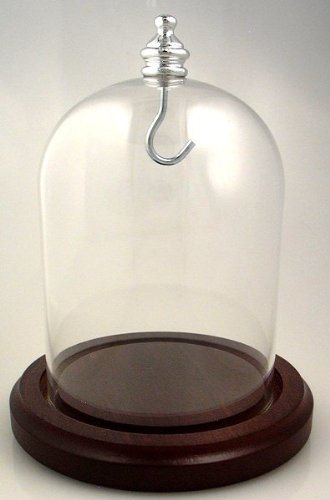
Accessory Review: Pocket Watch Glass Display Dome with Walnut Base & Silver hook (It's On Amazon)


After choosing the Marathon TSAR as the latest occupant of my watch box, I went searching for a storage solution for the pocket watches that I've been handed down and the one modern example - an Orient CDD00001W, one of the only modern pocket watches I know of that features a sapphire crystal - I keep on hand for occasions where a wrist-bound watch simply won't do.  Most boxes designed to store pocket watches have capacities far too large for my needs - usually in the 10 to 12 pocket watch range - so I went with a couple of single-watch glass cases from Amazon.

At just under $30, they're a reasonable storage and display option.  I keep the aforementioned Orient in one, and my great-grandfather's vintage Omega pocket watch in another.  It's a solid choice that keeps the watch well protected and nicely displayed, though getting the watch on the hook can be a little fidgety.  I highly recommend it to anyone who has a pocket watch or two and wants a good place to keep them safe.


Monday, October 7, 2013

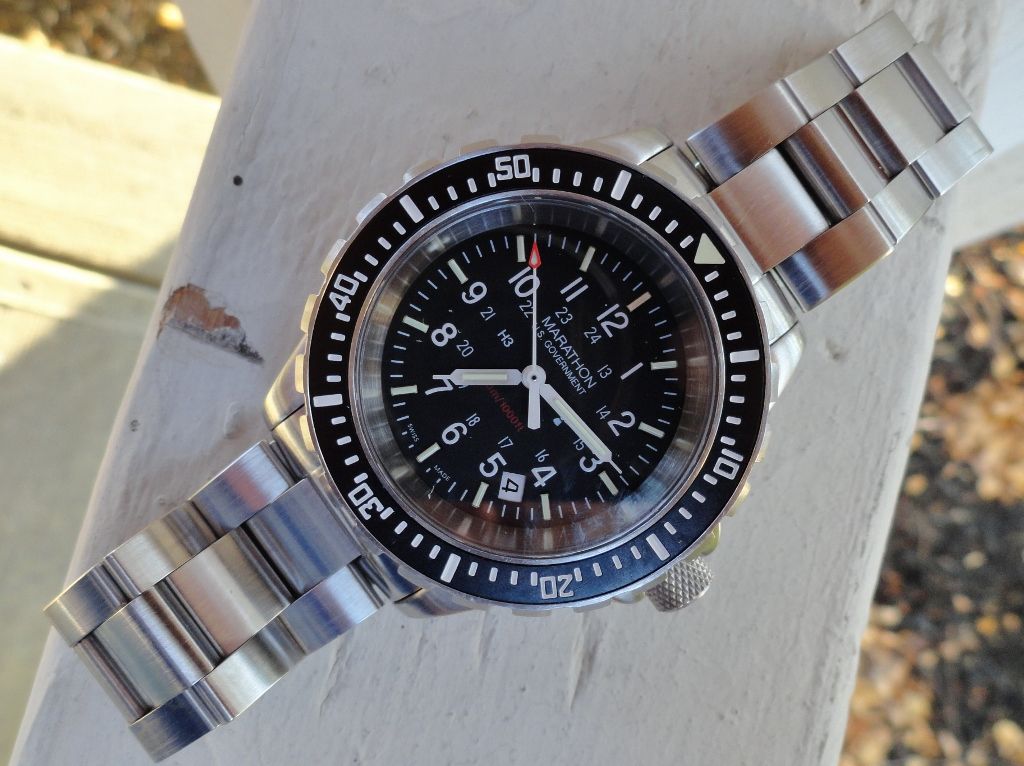
Watch Review: Marathon TSAR on U.S. Great Seal Bracelet


Spend enough time on any of the usual watch forums - especially where dive watches are discussed - and sooner or later you'll come across the Marathon Search-and-Rescue series of watches.  Marathon is a Canadian company that supplies Swiss-made watches to the U.S. and Canadian governments, and which has garnered a reputation for solid, purpose-built tool watches for those who value function first, form second.  As previous mainstay tool watches like the Rolex Submariner and the Omega Seamaster venture farther into fashion - some might say "bling" - territory, the backlash against that trend has led some dive watch enthusiasts to seek out the classic tool watch functionality and aesthetic from other sources.

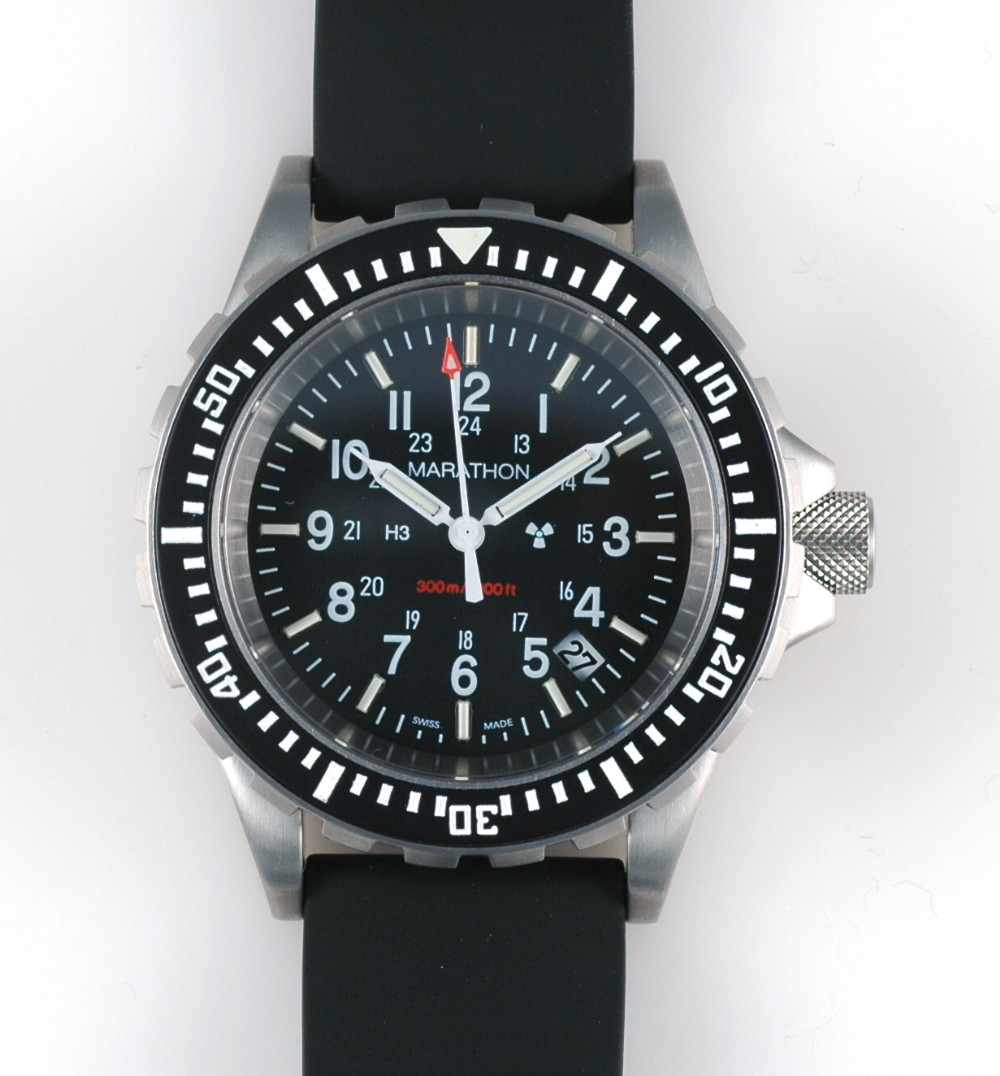
Marathon's SAR series comes in several flavors.  The TSAR is a quartz-powered watch with a sensible 41mm diameter.  The GSAR is its automatic-powered - by an ETA 2824, specifically - doppelganger.  The JSAR is an oversized version at 47mm.   And the CSAR tops out the line as the automatic Valjoux 7750-powered chronograph.

Given the playing field, my choice among Marathon's offerings was an easy one.  The TSAR combines the ruggedness of an ideal dive watch with the better (though not impervious) shock resistance and low maintenance of a quartz movement.  Despite its chunkiness, its 41mm diameter is very restrained in a world of 45mm+ monstrosities.  The TSAR is only available on a rubber strap that - like most "regular" length straps on the market today - proved too long for its innermost hole to accommodate a 6" wrist.  Even had the strap fit, though, I still would have opted to replace it with the very solid matching bracelet that Marathon offers emblazoned with either the U.S. great seal, a U.S. Marines seal, or the Canadian maple leaf.  Given that the TSAR version I picked up features the "U.S. Government" notation usually found on government contract Marathons, I figured the U.S. great seal bracelet would provide a nice counterbalance and round out the tool watch aesthetic of the TSAR.


The TSAR maintains all of the tool watch features that other formerly function-over-form watch models have shed in the pursuit of fashion:  drilled lug holes, a knurled crown, and a diver's bezel that is legible and functional from the full zero to 60 minutes.  The minute hand is just long enough to line up with the minute indices, and the tritium illumination is bright but not obnoxiously so under darkened conditions.

For me, the Achilles' heel of a quartz movement is how the sudden need for a battery replacement can leave you with a dead watch at the most inconvenient times.  The movement employed by the TSAR is one of several I've come across that fends off this contingency by including an end-of-life indicator that, in theory, should cause the movement to advance in 4-second increments when the battery needs changing.  With that mechanism, maintenance of the watch becomes a far easier and predictable proposition than another dime-a-dozen quartz or even a mechanical movement.

Shopping around for the greatest deal available at the time, I snagged the TSAR and its bracelet for $707 all together.  You might be able to find it for less depending on market conditions at the time, or if you are willing to go used and come across a solid example.  How ever you get your hands on it, I highly recommend it.


Monday, September 30, 2013

Watch Radar: Marathon TSAR (Tritium Search and Rescue) Diver


Following my abortively brief ownership of a Bathys 100F Auto, I decided that the watch that will eventually fill the "dive watch" role in my watch box should ideally have a quartz movement.  Aside from being more accurate across the board and slightly more shock resistant, a quartz movement would also require less unscrewing of the inevitable screw-down crown.  I'd hoped to acquire one of Bathys's next batch of 100F Quartzes, but a quick exchange with John Patterson revealed that the current ETA is well into 2014, if not later.  A year-or-two-away ETA has been the standard line from Bathys as to the quartz 100F for several years now (I think I've been asking since 2010), I finally decided to set aside my longstanding goal of adding a "Hawaii" brand to my watch box, in favor of the tool watch of choice for North American governmental agencies:  Marathon's TSAR.  Sensibly sized (at roughly 41-42mm wide) and as solid as 316L steel gets, the watch itself and its bracelet are currently en route in separate packages.

Monday, September 23, 2013

Watch Review: The Affordable (Under $30) Casio MTP-1239D-2A


Shortly after acquiring the Casio MTP-1183A-2A, I discovered its day-date variant, the MTP-1239D-2A.  I initially dismissed it as I presumed it would be largely the same as the 1183A, but a picture of its bracelet revealed a push-button clasp as opposed to the friction clasp on the 1183A.  The idea that I might be able to swap out the 1183A's friction clasp for a push button made me decide to take the plunge and pick up the 1239D.

When it arrived, the first thing I noticed was the blue of the dial.  While the 1183A's dial is a muted, almost violet shade, the 1239D's is closer to the vibrant blue I've seen in Seiko's SARB series and approaches the "electric" blue of the reference 2253.80 Omega Seamaster I used to own.   Looking at the image above, you might also notice that the positioning of the 12 o'clock indices is slightly more spaced on the 1239D's dial than the 1183A's.  I think it provides stronger proportionality to the entire layout.

The bracelet also yielded interesting differences upon closer inspection.  While virtually identical at first glance to the 1183A bracelet, its links are incompatible.  Moreover, the bracelet's finishing is more of a matte, frosted finish than the brushed finish on the 1183A.  Most surprising however was that the curve of the push-button clasp was less curved than the 1183A's clasp, making the fit much more angular and less appealing on my 6" wrist.  That, coupled with what seems to my eye to be a better, more aesthetically pleasing finish on the 1183A's bracelet, led me to end up choosing the exact opposite combination I intended to when I first acquired the 1239D:  The 1239D's head combined with the 1183A's bracelet.

Because of my watch box rule, the 1183A has been displaced by the 1239D, albeit in a hybridized form.  The assembled package of 1183A bracelet and 1239D watch head costs about $45, which still clocks in at less than the vast majority of watches out there.  And either the date-only 1183A or the day-date 1239D would make a fine single purchase, with the considerations raised above, at $20 and $25, respectively.